Pakistan Moves to Expel Afghan Medical Students: Right to Education and Protection
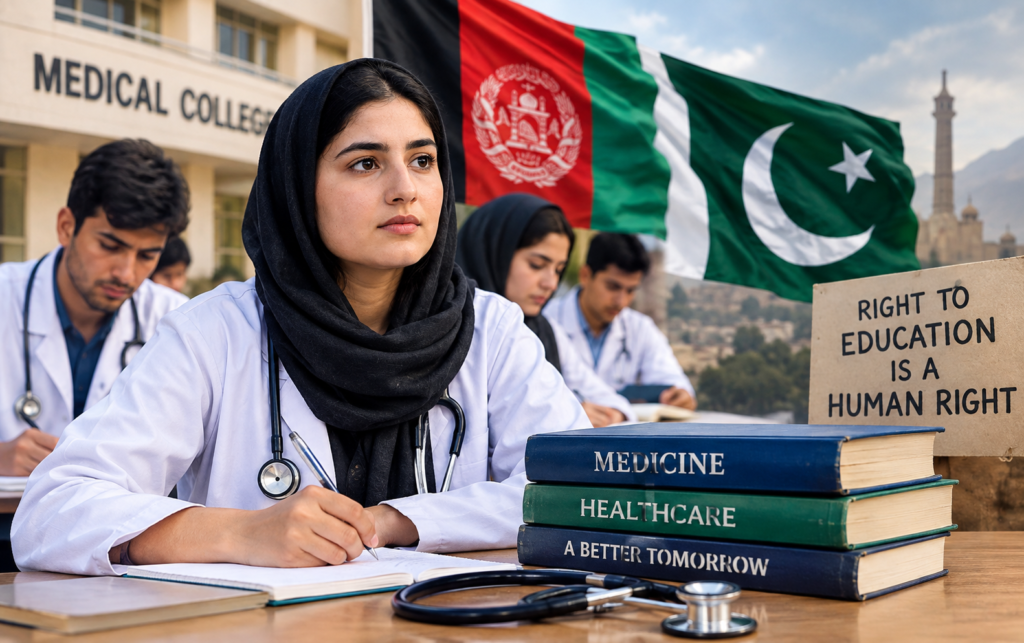
Afghan medical students in Pakistan and the human rights concerns surrounding access to medical education.

Pakistan’s reported decision to halt new admissions of Afghan medical and dental students and move toward the repatriation of those already enrolled has raised serious human-rights concerns. For students who have spent years studying medicine in Pakistan, the policy could mean interrupted degrees, financial losses, uncertainty about their futures and, in some cases, the loss of a pathway to becoming healthcare professionals.
Recent reporting says the Pakistan Medical and Dental Council (PMDC) has instructed medical and dental institutions not to admit Afghan students for the current academic session. Reports have also said that authorities are moving toward the repatriation of Afghan students already enrolled in Pakistani institutions.
The controversy goes beyond immigration policy. At its heart is a fundamental question: how should governments balance immigration and national-security policies with the right to education and the protection of students?
The PMDC Decision and Its Impact
The PMDC is Pakistan’s principal regulatory body for medical and dental education and professional standards. Its official regulations and notices govern medical and dental institutions across the country.
According to recent reports, the council has moved to stop Pakistani medical and dental institutions from admitting Afghan students during the current academic session. Reporting also indicates that existing Afghan students could be required to return to Afghanistan.
The decision has generated concern among students, rights advocates and others who argue that students who are already pursuing professional degrees should not have their education abruptly interrupted because of broader political tensions.
For an MBBS or dental student, losing access to university is not a minor inconvenience. Medical education can take many years and requires substantial financial, academic and personal investment.
Why This Is a Human Rights Issue
Education is recognized internationally as a fundamental human right.
Article 26 of the Universal Declaration of Human Rights recognizes the right to education and says higher education should be equally accessible on the basis of merit.
The International Covenant on Economic, Social and Cultural Rights also recognizes the right to education and calls for higher education to be made equally accessible on the basis of capacity.
This does not mean that foreign students automatically have an unrestricted right to remain in another country regardless of immigration law. States have legitimate authority to regulate visas, residency and access to educational institutions.
However, when immigration measures directly affect students who are already enrolled, human-rights questions arise about fairness, proportionality, non-discrimination, due process and continuity of education.
Students Should Not Become Victims of Political Tensions
Relations between Pakistan and Afghanistan have deteriorated in recent years, with disputes involving security, border issues and the status of Afghan nationals in Pakistan.
Pakistan has also expanded measures targeting Afghans who lack valid immigration documentation. A 2026 government directive reported by Dawn said Afghan nationals residing in Pakistan without valid visas could face arrest and that authorities were instructed to accelerate repatriation and deportation measures.
These wider policies create a difficult environment for Afghan students.
Students who have spent years building their lives around Pakistani universities may suddenly face questions about visas, residency, deportation and whether they can complete their degrees.
A student’s nationality should not erase the value of their education or their investment in becoming a doctor or dentist.
The Special Importance of Medical Education
The impact is particularly significant because the students affected are training for professions that are essential to public health.
Doctors and dentists require years of education and practical training. Interrupting their studies can waste skills, money and time while also reducing the number of trained healthcare professionals available in the future.
This concern is especially relevant to Afghanistan, where healthcare systems face substantial pressure.
UNICEF has warned that Afghanistan risks losing thousands of trained women teachers and healthcare workers because of continuing restrictions on women’s education and employment. Its 2026 analysis estimated that the country could lose up to 20,000 women teachers and 5,400 female healthcare workers by 2030.
Against this background, policies that interrupt the education of future Afghan healthcare professionals deserve careful humanitarian consideration.
Afghanistan’s Education Crisis Makes the Issue More Urgent
The situation is particularly serious for Afghan students because Afghanistan is already facing a severe education crisis.
UNICEF reported in August 2026 that more than 2.6 million Afghan girls had been denied secondary education since 2021. Afghanistan remains the only country where secondary and higher education are effectively closed to girls and women.
For Afghan students who have managed to access higher education abroad, including medical education, losing that opportunity can have profound consequences.
Returning students to a country where educational opportunities are already severely restricted could make it extremely difficult for some of them to continue their studies.
This is why the treatment of Afghan students should be considered not only through the lens of immigration but also through the lens of education, human dignity and protection.
The Principle of Non-Discrimination
Human rights law places strong importance on equality and protection against discrimination.
Education should be accessible without arbitrary discrimination. The United Nations Human Rights Council has reaffirmed that the right to education applies to everyone and is recognized in several international human-rights instruments.
This does not eliminate a state’s ability to establish reasonable rules for international students.
But any policy affecting a particular nationality should be carefully assessed to determine whether it is necessary, proportionate and fairly implemented.
The authorities should also consider the circumstances of students who are already enrolled, rather than treating them in exactly the same way as people seeking new admission.
Existing Students Need a Fair Transition
If Pakistan ultimately requires Afghan medical students to leave, authorities should consider measures that protect students from losing years of education.
Possible safeguards could include:
- Allowing students already enrolled to complete their current degrees.
- Providing sufficient time to arrange legal status or transfer to another institution.
- Issuing clear written decisions and appeal procedures.
- Protecting students from arbitrary detention or deportation while legitimate legal cases are pending.
- Helping students transfer academic credits where continuation in Pakistan is impossible.
- Coordinating with Afghan and international educational institutions to provide alternatives.
- Ensuring that students with valid documentation are treated according to clear and transparent rules.
Such measures would allow Pakistan to enforce immigration regulations while reducing unnecessary harm to students.
Legal Challenge Highlights the Growing Concern
The issue has already moved into the legal arena. Recent reporting indicates that a petition has been filed before the Lahore High Court challenging PMDC directives concerning the repatriation of Afghan students.
The legal proceedings will be important because they may clarify the authority behind the policy and the rights of students already enrolled in Pakistani institutions.
The Human Rights Commission of Pakistan has also reportedly criticized the decision to rusticate Afghan students.
These developments demonstrate that the controversy is no longer simply an immigration issue. It has become a wider debate about education, equality and the protection of vulnerable people.
Pakistan’s Responsibility Toward Education and Human Dignity
Pakistan has hosted millions of Afghans over decades, and educational institutions have played an important role in providing opportunities to Afghan students.
That history makes the current situation particularly important.
A responsible approach should recognize Pakistan’s legitimate concerns about immigration and security while also protecting students who have already established academic lives in the country.
Human rights are most meaningful when they are protected during difficult political circumstances.
Students should not be forced to carry the consequences of disputes between governments when they are simply trying to study, graduate and build professional lives.
What Should Happen Next?
Pakistan’s authorities should provide transparent information about the exact legal basis, implementation timetable and scope of the PMDC directive.
Students also need clarity about their individual circumstances, including visas, university enrollment, examinations, clinical training and graduation requirements.
Universities should communicate directly with affected students and ensure that no student is left without information about their academic future.
At the same time, human-rights organizations and international bodies should monitor the situation and encourage solutions that protect education while respecting legitimate immigration requirements.
Conclusion
Pakistan’s move against Afghan medical students raises important questions about the right to education, equality, due process and human dignity.
Governments have the right to regulate immigration and national security. But those powers should be exercised in a way that avoids unnecessary harm to students who have already invested years of their lives in education.
For Afghan medical and dental students, this is not simply a question of where they live. It is about whether they can finish the education they have worked years to achieve.
A balanced solution should protect Pakistan’s legitimate interests while ensuring that Afghan students are treated fairly, transparently and with respect for their fundamental human rights.
Education should build bridges between societies—not become another casualty of political conflict.