Kurram Shia Passenger Convoy Attack: 43 Killed on November 21, 2024
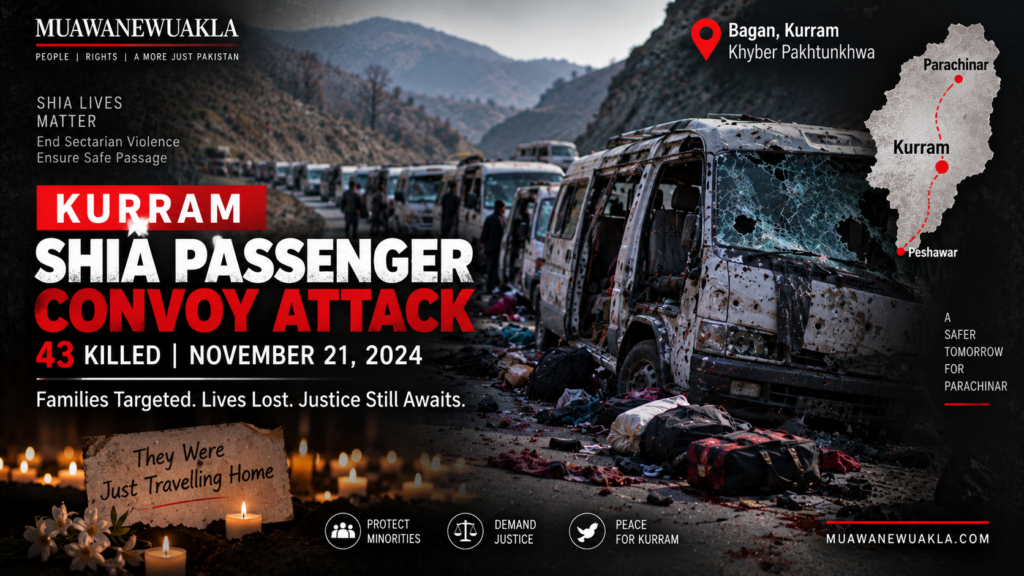
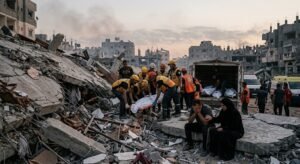
Kurram Shia passenger convoy attack on November 21, 2024, in which 43 people were killed while travelling between Parachinar and Peshawar.

November 21, 2024 | Kurram, Khyber Pakhtunkhwa, Pakistan
At least 43 people were killed and 16 injured when a passenger convoy carrying Shia civilians came under heavy gunfire in Kurram, Khyber Pakhtunkhwa, on November 21, 2024.
The convoy was travelling between Parachinar and Peshawar when attackers opened fire near the Bagan area. Women and children were among those killed, making the incident one of the deadliest attacks against Shia civilians in Pakistan during 2024. Dawn’s report on the rising Kurram death toll
The attack triggered another wave of violence in Kurram and deepened an already serious humanitarian and security crisis affecting the Shia-majority population around Parachinar.
Shia Passenger Convoy Attacked in Kurram
The convoy was travelling along the route connecting Parachinar with Peshawar when it came under attack.
According to Dawn’s initial report on the Kurram convoy attack, the convoy consisted of around 200 vehicles and was travelling under police escort when gunmen opened fire in the Mandori/Bagan area.
Initial reports put the death toll at 38. As injured victims later died, authorities reported that the number had risen to 43, while 16 people were injured.
The attack was devastating for families travelling through an area that had already experienced months of insecurity.
For many residents of Parachinar, this road is not simply a route between two cities. It is a vital connection to hospitals, markets, schools, workplaces and the rest of the province.
Women and Children Among Those Killed
The attack was particularly tragic because civilians, including women and children, were among the victims.
Dawn reported that the dead included seven women and three children, while 16 others were injured. Dawn’s detailed report on the Kurram attack
These were ordinary passengers travelling along a major road.
They were not combatants.
They were families trying to reach their destinations safely.
The killing of civilians in such circumstances raises serious questions about security arrangements and the protection available to vulnerable communities travelling through conflict-affected areas.
A Journalist Was Among the Victims
The attack also claimed the life of Janan Hussain, a journalist from Parachinar.
According to Dawn, Hussain had recently returned from Malaysia and was known for his community work and journalism. His family reportedly spent hours searching for him before his body was identified. Dawn’s report on the victims
His death illustrates why casualty figures alone cannot capture the human cost of an attack.
Every victim had a family, a profession, relationships and plans for the future.
Was the Kurram Attack Sectarian?
The November 21 attack occurred in an area with a long and complicated history of sectarian tensions, tribal disputes and militant violence.
The convoy was carrying members of the Shia community, and local officials described the victims as Shia passengers. The South Asia Terrorism Portal also recorded the attack as involving Shia passengers travelling between Parachinar and Peshawar. South Asia Terrorism Portal — Kurram violence assessment
However, the circumstances surrounding the attack were more complicated than a simple sectarian confrontation.
Officials also linked the violence to a longstanding land dispute between local tribes, while the identity of the attackers and their organizational affiliation remained uncertain in the immediate aftermath. Dawn’s report on the circumstances of the attack
For responsible journalism, it is important to distinguish between established facts and disputed explanations.
What is clear is that a convoy carrying Shia passengers was attacked and dozens of civilians were killed.
The precise motive and responsibility should be established through a credible investigation.
Kurram’s Shia Community Already Under Pressure
The attack did not happen in isolation.
Kurram had already experienced months of violence and insecurity. The November 21 massacre intensified tensions and contributed to further fighting between armed groups and rival communities.
According to Dawn, the wider violence following the attack killed at least 64 people and injured more than 70 within three days before a temporary ceasefire was reached. Dawn’s report on the wider Kurram violence
For the Shia population of Parachinar and surrounding areas, the consequences went beyond the loss of life.
Road closures created shortages of food, medicines and other necessities. Schools and businesses were affected, while residents struggled to travel safely.
The humanitarian consequences are also connected to the wider issue of attacks against vulnerable Shia communities documented in our report, Hazara Community Under Threat: Targeted Killings and the Right to Life in Pakistan.
The Humanitarian Crisis After the Attack
When the main road to Parachinar becomes inaccessible, residents can face serious difficulties obtaining basic necessities.
Hospitals need medicines. Families need food. Students need access to schools. Workers need to travel. Businesses depend on functioning roads.
A prolonged blockade can therefore become a humanitarian emergency even when there is no active shooting.
By December 2024, the situation had become so severe that medicines and other essential supplies were being transported to Parachinar by air ambulance. Dawn’s report on the humanitarian crisis in Kurram
This demonstrates why protecting roads and civilian movement must be an essential part of any lasting peace arrangement in Kurram.
Security Arrangements Under Question
The convoy reportedly contained around 200 vehicles and was travelling with police protection.
Yet attackers were still able to launch sustained gunfire against the passengers. Dawn’s initial report on the convoy attack
That raises a serious question:
If authorities knew the route was vulnerable, why were civilians unable to receive adequate protection?
Security cannot begin only after an attack has happened.
Authorities must assess threats beforehand, protect vulnerable routes and ensure that civilians can travel without being exposed to preventable danger.
The Violence Continued
The November 21 attack was followed by further clashes across Kurram.
According to SATP, attacks and clashes between November 21 and November 23 resulted in 82 deaths and 156 injuries, with local administration figures indicating that 66 of those killed were Shia and 16 were Sunni. South Asia Terrorism Portal — Kurram violence assessment
These figures demonstrate how quickly a single attack can trigger a wider cycle of violence.
They also show why Kurram’s crisis should not be reduced to collective blame against an entire religious community.
Ordinary Shia and Sunni civilians have both suffered from violence.
The responsibility belongs to the individuals and armed groups that commit or facilitate attacks—not to entire communities.
Justice for the Victims
The November 21 Kurram attack deserves a full and transparent investigation.
Authorities should establish:
- Who planned and carried out the attack?
- Why was the passenger convoy targeted?
- Were there prior intelligence warnings?
- Why was the convoy unable to receive adequate protection?
- Who provided weapons or logistical support to the attackers?
- Have those responsible been identified and prosecuted?
The families of the victims deserve answers.
They also deserve justice through a fair legal process.
Condemnation alone cannot bring lasting security to Kurram.
Shia Citizens Have the Right to Travel Safely
For residents of Parachinar, travelling toward Peshawar should not be a journey defined by fear.
The right to life belongs equally to every Pakistani.
The right to security does not depend on sect.
And civilians should not have to choose between remaining trapped in their homes and risking their lives on the road.
The principles discussed in our coverage of freedom of peaceful assembly in Pakistan and freedom of expression in Pakistan are part of the same broader human-rights principle: citizens must be able to exercise their fundamental rights without intimidation or violence.
The November 21 Kurram attack should therefore be remembered as a devastating loss of civilian life and as a warning about the consequences of allowing sectarian and armed violence to continue unchecked.
Forty-three people lost their lives. Their families deserve justice, and the people of Kurram deserve a future where travelling home does not mean travelling into danger.
About the Reporter
This report was written by Qundeel Hassan, Senior Journalist and Human Rights Activist at Muawanewuakla.
Qundeel Hassan reports on human rights, sectarian violence, minority rights, freedom of expression, justice and attacks against vulnerable communities in Pakistan.
Read more of his reporting on the Qundeel Hassan author page.