Four Shia Vendors Killed in Hazarganji, Quetta, in Targeted Attack
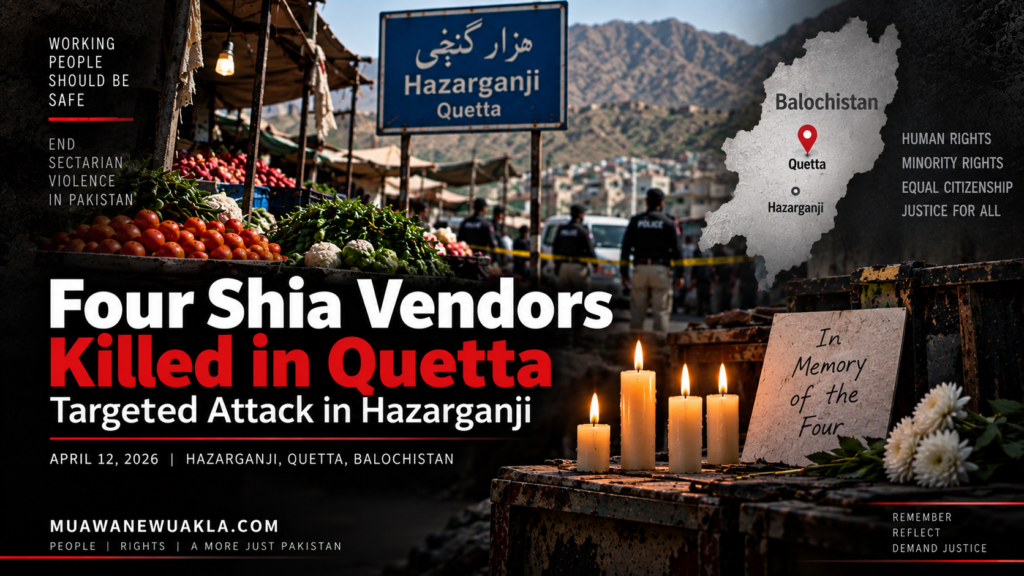
Four Shia vendors were killed in a targeted attack in Hazarganji, Quetta, on April 12, 2026.

April 12, 2026 | Quetta, Balochistan
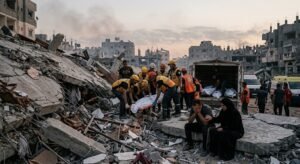
Four members of the Hazara Shia community were killed in a targeted shooting in the Hazarganji area of Quetta on April 12, 2026, in an attack that once again raised serious concerns about the safety of Hazara citizens in Balochistan.
The victims were vegetable vendors who had gone to the Hazarganji Sabzi Mandi for their routine work. According to later incident reporting, armed attackers opened fire on Shia Hazara vegetable sellers at around 8 a.m. before escaping from the area. The Islamic State Pakistan Province (ISPP), also referred to in some reporting as ISKP, later claimed responsibility for the attack.
Four Hazara Shias Killed While Working
The attack struck people engaged in ordinary economic activity. They were vendors working in a vegetable market—not combatants or political figures.
Initial reports on April 12 gave a lower death toll. Dawn reported that two Hazara men were killed and three others injured after unidentified gunmen opened fire on people returning from the Hazarganji vegetable market to Hazara Town. Police described the incident as a suspected targeted killing and launched a search operation.
Other reporting later placed the death toll at four. The Balochistan Post reported that four members of the Hazara community were killed in Hazarganji, while SATP subsequently recorded the incident as the killing of four Shia Hazara persons.
This difference in early casualty figures is important. In breaking-news incidents, death tolls can change as hospitals and authorities confirm additional fatalities.
ISPP Claims Responsibility
According to the South Asia Terrorism Portal, ISPP claimed responsibility for the attack after four Shia Hazara people were killed in the Hazarganji vegetable market area. SATP attributed the incident information to The Khorasan Diary.
The responsibility claim should be distinguished from the initial police reporting. Police initially described the attackers as unidentified and did not publicly attribute the shooting to a particular organization.
That distinction matters when reporting sectarian violence: a militant group’s later claim of responsibility is evidence of its claimed involvement, but it should not be presented as independently established fact unless authorities or other reliable evidence corroborate it.
Hazara Community Again Faces Fear
For Hazara Shias in Quetta, attacks on marketplaces and other everyday spaces have a particularly painful history.
The Human Rights Commission of Pakistan has repeatedly documented the vulnerability of the Hazara Shia community in Balochistan. HRCP has previously described targeted attacks against Hazaras and called for stronger state action against militant groups responsible for sectarian violence.
A market should be a place where people can work, earn a living and return home to their families. When vendors cannot safely travel to a vegetable market because of their ethnic or religious identity, the problem goes far beyond one shooting. It becomes a fundamental question of citizenship and equal protection under the law.
A History of Anti-Shia Violence in Quetta
The Hazara community has endured decades of targeted violence in Quetta and elsewhere in Balochistan.
Human-rights reporting has documented attacks against Hazara Shias in marketplaces, on roads and in other public spaces. HRCP has previously noted that Hazara citizens have faced restrictions on movement and have often required security protection simply to carry out ordinary activities.
Pakistan’s National Counter Terrorism Authority has also documented the role of extremist organizations and sectarian militancy in Balochistan. NACTA’s terrorism research has discussed attacks against Hazaras around Quetta and the role historically attributed to Lashkar-e-Jhangvi in anti-Shia violence.
However, each incident must be reported on its own evidence. Historical involvement of an extremist organization should not automatically be treated as proof that the organization carried out a particular attack.
The Right to Live Without Fear
As a Shia journalist and human-rights advocate, I believe the killing of Hazara Shias cannot be reduced to another statistic in Pakistan’s long record of sectarian violence.
Four people went to work and did not return home.
Their families lost fathers, brothers, relatives and sources of income. Their community was left once again to mourn and ask why ordinary citizens continue to be targeted because of who they are.
The state has a responsibility to protect every citizen regardless of sect, ethnicity or background. Security cannot mean simply deploying personnel after an attack. It must also mean preventing attacks, investigating them effectively and ensuring that those responsible face justice through due process.
Justice Must Not Stop at Condemnation
Every attack on Hazara Shias deserves more than statements of condemnation.
Authorities should conduct a transparent investigation, establish the identities of the attackers, determine how they were able to carry out the attack, and bring anyone responsible to justice through the courts.
The families of the victims deserve answers. The injured deserve care. And the Hazara community deserves the freedom to work, travel, study and worship without living under permanent fear.
Pakistan cannot claim to protect minority rights while citizens continue to be targeted for their religious or ethnic identity.
The killing of four Hazara Shia vendors in Hazarganji should therefore be treated not merely as another violent incident in Quetta, but as a serious test of the state’s commitment to the right to life, equal citizenship and human dignity.
Read Similar Cases
- Hazara Community Under Threat: Targeted Killings and the Right to Life in Pakistan
- Freedom of Expression in Pakistan: Is Dissent Under Threat?
- Freedom of Peaceful Assembly in Pakistan
- Qundeel Hassan — Journalist & Human Rights Activist