Islamabad Shia Mosque Suicide Bombing: 31 Killed During Friday Prayers
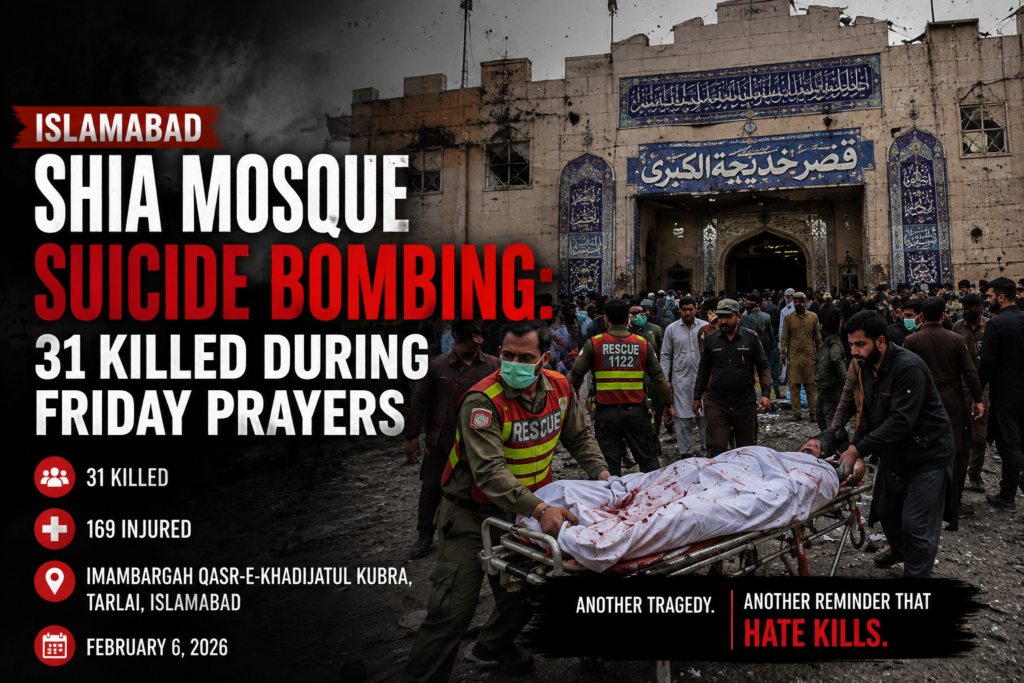
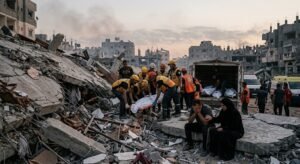
News graphic illustrating the February 6, 2026 suicide bombing at a Shia mosque in Islamabad.

ISLAMABAD, Pakistan — February 6, 2026: A suicide bombing tore through a Shia mosque in Islamabad during Friday prayers, killing at least 31 people and injuring 169 others, according to Pakistani authorities. The attack struck Imambargah Qasr-e-Khadijatul Kubra in the Tarlai area of Islamabad, turning a place of worship into the scene of one of the capital’s deadliest attacks in years.
The explosion occurred as worshippers gathered for Friday prayers. Witnesses described gunfire near the entrance followed by a powerful blast that sent panic through the mosque and surrounding area.
The Islamic State claimed responsibility for the attack, according to Reuters. Pakistani authorities launched an investigation into the bombing and the networks believed to be connected to the assailant.
The bombing has renewed concerns over the security of Pakistan’s Shia Muslim community and the ability of authorities to protect religious minorities at places of worship.
What Happened at the Islamabad Shia Mosque?
The attack took place on Friday, February 6, 2026, at Imambargah Qasr-e-Khadijatul Kubra in Tarlai, southeastern Islamabad.
According to Pakistani authorities cited by Dawn, the attacker was stopped at the mosque’s entrance after security personnel confronted him. The assailant then detonated an explosive device. Reports also described gunfire before the explosion.
The blast struck worshippers during the Friday congregation, causing mass casualties inside and around the mosque.
Images and eyewitness accounts from the scene showed a devastating aftermath, with injured worshippers being transported to hospitals while families gathered desperately for information about relatives.
31 People Killed and 169 Injured
The human cost of the attack was severe.
Authorities reported that 31 people were killed and 169 injured. The wounded were transported to hospitals in Islamabad, where medical teams treated victims suffering from blast and gunshot injuries.
The number of casualties made the bombing one of the most serious attacks against civilians in Islamabad in more than a decade.
Among those affected were ordinary worshippers who had gathered for Friday prayers — illustrating the devastating consequences when places of worship become targets of terrorism.
Islamic State Claims Responsibility
The Islamic State claimed responsibility for the bombing,The claim is significant because Islamic State and its regional affiliates have previously targeted Shia Muslims in Pakistan and elsewhere in South Asia.
However, responsibility for a terrorist attack should be distinguished from broader political or sectarian narratives. The responsibility claim is an important part of the investigation, but authorities must still establish the attacker’s identity, network, financing and operational links through evidence.
The attack should also not be used to portray Sunni Muslims generally as responsible for violence. The perpetrators identified or claimed by investigators are militant organizations and individuals, not an entire religious community.
Why Was the Mosque Targeted?
The bombing occurred at a Shia place of worship, making the attack particularly significant in the context of Pakistan’s history of sectarian violence.
Shia Muslims have repeatedly been targeted by extremist organizations in Pakistan, including Islamic State-linked militants and other sectarian groups.
The Parachinar-Peshawar Shia Convoy Attack reported by Muawanewuakla is another example of the dangers faced by Shia civilians in areas affected by sectarian violence.
These incidents demonstrate why protection of religious minorities must remain a central human-rights and security concern.
Security at the Mosque Came Under Scrutiny
The Islamabad bombing also raised questions about security arrangements at religious sites.
According to reports, security personnel confronted the attacker at the entrance before the explosion.
That intervention may have prevented the attacker from reaching an even more crowded area of the mosque. Nevertheless, the large number of casualties has prompted questions about whether existing security measures were sufficient to protect worshippers.
Places of worship should not become easy targets for armed groups. Effective security requires more than guards at entrances. It can include intelligence gathering, threat assessments, emergency response planning, surveillance and coordination between local communities and law-enforcement agencies.
Islamabad Mosque Bombing and Pakistan’s Sectarian Violence
The attack cannot be viewed in isolation from Pakistan’s longer history of sectarian violence.
Shia communities have faced attacks in different parts of the country, including Khyber Pakhtunkhwa, Balochistan, Punjab and Sindh.
In Kalabagh, Mianwali, two Shia men were killed and more than 30 people were injured during a sectarian clash surrounding a Chehlum procession in August 2024. Police investigated the violence and terrorism-related charges were registered. Reports also said police suspected possible involvement of Lashkar-e-Jhangvi, although such allegations should be distinguished from a judicial finding of responsibility.
This history makes the Islamabad bombing particularly alarming: violence against Shia civilians remains a serious challenge to the right to life and freedom of religion.
The Human Rights Dimension
The bombing raises fundamental human-rights questions.
Every person has the right to life, security and freedom of religion. Worshippers should be able to attend a mosque, imambargah, church, temple or other place of worship without fearing that they may be attacked because of their religious identity.
Pakistan’s Constitution provides protections relating to religious freedom and the security of citizens. International human-rights standards likewise recognize freedom of religion or belief and the right to life.
The United Nations Office of the High Commissioner for Human Rights provides extensive international guidance on freedom of religion or belief and protection of fundamental rights.
The Islamabad bombing therefore represents more than a security incident. It is also an attack on civilians exercising their right to worship.
A Growing Concern for Shia Muslims
The bombing adds to a long record of attacks and insecurity experienced by Shia communities in Pakistan.
From attacks on religious gatherings to violence against travellers and community leaders, sectarian militancy has repeatedly placed Shia civilians at risk.
The experience of Pakistan’s Hazara Shia community provides another important example. Muawanewuakla has previously examined this issue in Hazara Community Under Threat: Targeted Killings and the Right to Life in Pakistan.
The pattern demonstrates why the protection of minorities cannot depend solely on security responses after an attack has already occurred.
Accountability Must Follow the Islamabad Bombing
A deadly attack of this scale requires a transparent and comprehensive investigation.
Authorities should establish:
- Who planned and facilitated the attack?
- How was the attacker able to reach the mosque?
- Who provided logistical or financial support?
- Were there warning signs before the bombing?
- Were security agencies aware of a threat?
- What networks were connected to the attacker?
- Were previous intelligence warnings adequately acted upon?
- Will those responsible for planning and facilitating the attack face prosecution?
Accountability is essential not only for the victims’ families but also for preventing future attacks.
An investigation should be based on evidence and due process rather than assumptions or collective blame.
Protecting Places of Worship
The Islamabad bombing highlights the need for stronger protection of religious sites across Pakistan.
Authorities can work with religious communities to improve security while ensuring that measures do not unnecessarily interfere with religious practice.
Long-term prevention also requires addressing extremist recruitment, sectarian propaganda and networks that encourage violence against religious minorities.
Security measures can stop individual attacks, but lasting peace requires confronting the ideology and organizational structures that enable sectarian violence.
Freedom of Religion Must Be Protected
Freedom of religion is closely connected to other fundamental rights, including freedom of assembly, expression and personal security.
The right to peacefully gather for religious worship is part of the broader question of whether citizens can participate freely in public and religious life.
Muawanewuakla’s reporting on Freedom of Peaceful Assembly in Pakistan examines the wider constitutional and human-rights protections surrounding peaceful gatherings.
The Islamabad bombing shows why these rights require meaningful protection in practice, not simply recognition on paper.
Remembering the Victims
Behind the casualty figures are families who lost parents, children, siblings and loved ones.
For those injured, the consequences can continue long after the immediate emergency ends. Survivors may face physical injuries, psychological trauma and financial hardship.
For families of those killed, no investigation can undo the loss.
Their suffering should remain central to any discussion of terrorism and sectarian violence.
Conclusion
The February 6, 2026 Islamabad Shia mosque suicide bombing was a devastating attack on worshippers gathered for Friday prayers.
At least 31 people were killed and 169 were injured, according to authorities. The Islamic State claimed responsibility, while Pakistani authorities began investigating the attack and those connected to it.
The tragedy raises serious questions about terrorism, religious freedom, civilian protection and the security of places of worship in Pakistan.
Protecting Shia Muslims — and every religious community — requires effective law enforcement, intelligence gathering, accountability and a firm rejection of sectarian violence.
No person should have to fear death simply for attending Friday prayers.
About the Author
Qundeel Hassan is a Senior Journalist and Human Rights Activist covering human rights, minority rights, sectarian violence, social justice and important developments in Pakistan and around the world.
Read more reporting by Qundeel Hassan on Muawanewuakla.
Sources and Further Reading
- Dawn — At least 31 killed, 169 injured in suicide bombing at Islamabad imambargah
- Reuters — At least 31 killed in Islamabad Shi’ite mosque bombing; Islamic State claims responsibility
- Al Jazeera — At least 31 killed, dozens wounded in suicide blast at Islamabad mosque
- Associated Press — Suicide bombing at Shiite mosque in Islamabad
Tags: Islamabad Mosque Bombing, Islamabad Shia Mosque, Shia Muslims, Shia Killing, Sectarian Violence, Islamic State, Terrorism in Pakistan, Religious Freedom, Human Rights, Friday Prayers, Pakistan, Minority Rights