Sahiwal Shia Man Faces Blasphemy and Terrorism Charges After Dispute
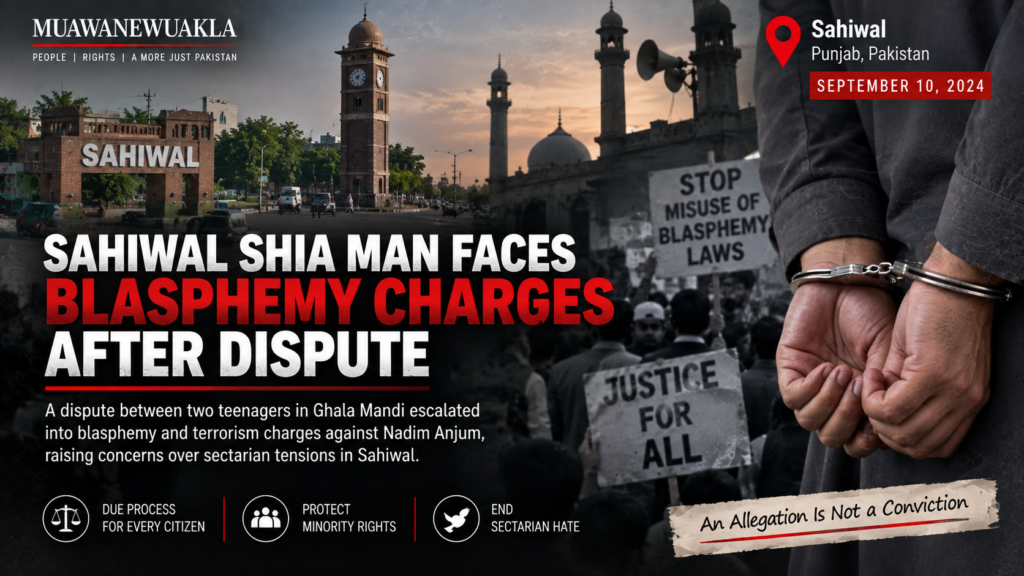
A news graphic about the September 10, 2024 Sahiwal incident involving Shia man Nadim Anjum and subsequent blasphemy charges.

September 10, 2024 | Ghala Mandi, Sahiwal, Punjab, Pakistan
A minor dispute between two teenagers in Sahiwal’s Ghala Mandi area escalated into a serious sectarian and security incident after Nadim Anjum, a Shia man, was accused of blasphemy and subsequently arrested under blasphemy and terrorism laws.
According to a report carried by PTI and published by ThePrint, the incident began when two teenage boys, identified as Talha and Muneeb, reportedly became involved in a dispute on September 10, 2024. During the confrontation, Talha contacted his father, Nadim Anjum. Police said Anjum allegedly arrived with a pistol and assaulted Muneeb.
What followed transformed a personal dispute into a much wider and potentially dangerous sectarian confrontation.
How the Sahiwal Dispute Escalated
Police said Muneeb’s father, identified as Muhammad Umar and described as a local mosque prayer leader, subsequently accused Anjum of insulting companions of the Prophet.
The accusation was particularly serious because Anjum is Shia.
According to police, an announcement was made from the mosque alleging that Anjum had committed blasphemy. A large number of people then moved toward his residence. Police intervened and took Anjum into custody.
Anjum denied the blasphemy allegation. He reportedly maintained that the accusation was connected to the earlier dispute involving the two boys and alleged that Muneeb’s father was attempting to settle a personal score with him.
That distinction is important: the blasphemy allegation was an accusation, not an established finding of guilt.
Police Protection Prevented a Potentially Worse Outcome
The situation became even more dangerous when a crowd reportedly gathered and moved toward the police station.
According to police cited by PTI, activists associated with Tehreek-e-Labbaik Pakistan (TLP) were among those who reached the police station and demanded that Anjum be handed over to them.
Police refused to surrender him and instead registered a case under the relevant provisions of Pakistani law. The crowd subsequently dispersed after being told that charges had been registered.
Anjum’s family members reportedly left the town because of fears for their safety.
The case illustrates how quickly a personal disagreement can become a life-threatening situation when a blasphemy accusation is introduced into a dispute.
Charges Against Nadim Anjum
Police registered a case against Anjum under Sections 298, 298-A and 506 of the Pakistan Penal Code, along with Section 7 of the Anti-Terrorism Act, according to the contemporary reporting.
However, the existence of criminal charges does not itself establish that the allegations are true.
A fair investigation requires that allegations be tested through evidence and due process rather than through public pressure, mob demands or sectarian mobilisation.
Why This Case Matters for Pakistan’s Shia Community
For Pakistan’s Shia community, the Sahiwal incident raises concerns that go beyond one individual case.
When an ordinary dispute can rapidly develop into a blasphemy allegation, a gathering of people outside a home and demands for an accused person to be handed over to a crowd, the potential consequences can be devastating.
Pakistan has witnessed cases in which blasphemy allegations have triggered mob violence before courts have had an opportunity to examine the evidence.
For minority communities, including Shia Muslims, the fear can be particularly acute when religious accusations become intertwined with sectarian differences.
The case therefore deserves attention not only as a criminal investigation but also as a human-rights and rule-of-law issue.
An Allegation Is Not a Conviction
The most important principle in this case is simple: an accusation must not be treated as proof of guilt.
Nadim Anjum denied the blasphemy allegation, according to the contemporary police account.
The proper course is an impartial investigation, evidence-based prosecution and a judicial determination.
No individual should be subjected to violence because of an accusation, regardless of the religious issue involved.
Likewise, legitimate concerns about religious offences should be dealt with through the legal system rather than through mob pressure or threats.
Protecting Minority Citizens
The Sahiwal incident also highlights the responsibility of the state to protect vulnerable citizens.
Police intervention reportedly prevented the crowd from taking Anjum from custody. That intervention was critical because handing an accused person over to a crowd could have resulted in irreversible consequences.
Pakistan’s commitment to the rule of law must mean that every citizen receives protection, including people accused of serious offences.
The state must also ensure that religious identity does not become a reason for discrimination, intimidation or violence.
Muawanewuakla has previously reported on the wider challenges facing vulnerable communities, including the threat of targeted violence against the Hazara community in Pakistan and freedom of expression in Pakistan.
The Human Cost of Sectarian Accusations
Behind every blasphemy accusation is a human being whose safety can suddenly be placed at risk.
In this case, the reported consequences extended beyond Anjum himself. His family reportedly left the town to protect themselves after the accusation and the subsequent mobilisation of people.
This is why authorities must take threats surrounding religious accusations seriously.
A society governed by law cannot allow accusations to become a substitute for evidence or crowds to become substitutes for courts.
Justice Must Prevail
The Sahiwal incident of September 10, 2024, demonstrates how quickly a dispute between individuals can escalate into a major sectarian and security concern.
The case should be resolved through evidence, due process and an independent judicial process.
Nadim Anjum’s religious identity should not determine whether he receives justice. Nor should any accusation be used to justify violence against him or his family.
The protection of life, dignity and due process must remain above sectarian pressure.
Pakistan’s minorities deserve the same security and legal protection as every other citizen.
No accusation should become a death sentence. No crowd should replace a court. And no citizen should have to flee their home because of a religious allegation.
Sources
The primary contemporary account used for this report is the PTI report published by ThePrint on September 11, 2024.
A second publication carrying the same PTI report is available through The Week.
About the Author
This report was written by Qundeel Hassan, Senior Journalist and Human Rights Activist at Muawanewuakla. His reporting focuses on human rights, sectarian violence, minority rights, freedom of expression, justice and attacks against vulnerable communities in Pakistan.
Read more of his reporting on the Qundeel Hassan author page.