Kalabagh Mianwali Sectarian Clash: Two Shia Men Killed in Punjab
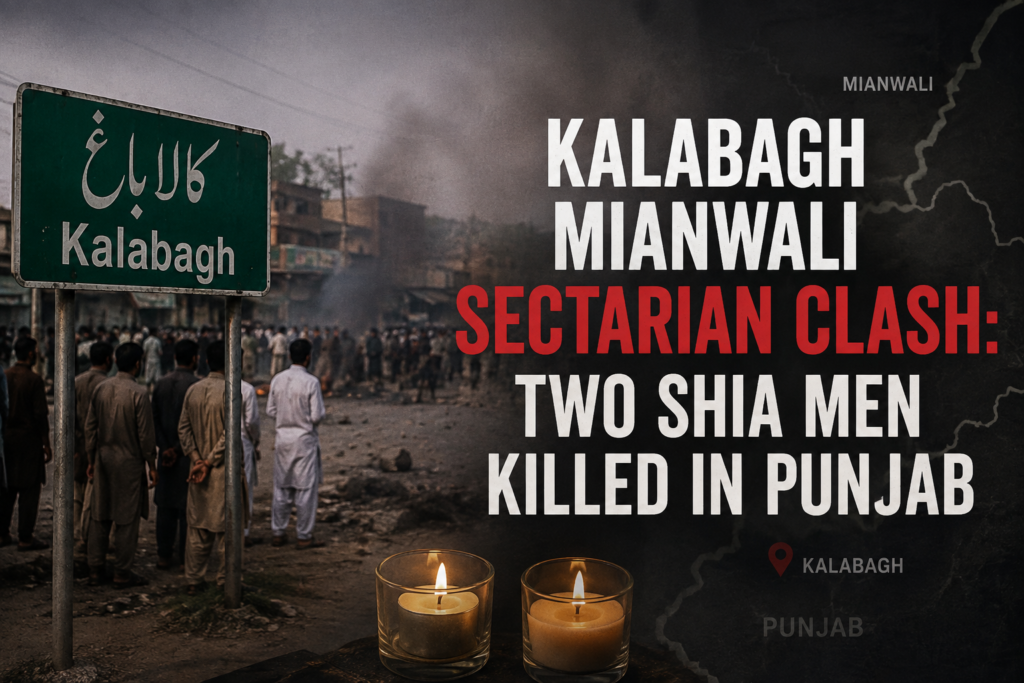
Sectarian violence in Kalabagh, Mianwali, during the August 2024 Chehlum procession left two Shia men dead and more than 30 people injured.

Two Shia men were killed and more than 30 people injured when an armed sectarian clash erupted in Kalabagh, Mianwali district, Punjab, in August 2024 over the route of a Chehlum procession commemorating Imam Hussain.
The violence turned a dispute over the procession route into a deadly confrontation. According to police and media reports, most of those injured were Shia, while authorities subsequently deployed police and Rangers to restore order in the town.
The Kalabagh incident highlighted continuing concerns about sectarian tensions, the security of religious processions and the protection of Pakistan’s Shia Muslim community.
What Happened in Kalabagh, Mianwali?
The confrontation began after tensions developed between members of the Shia and Sunni communities over the route of a Chehlum procession in Kalabagh.
According to Dawn’s report on the Kalabagh clash, the two sides had previously reached an agreement concerning the procession route in the presence of the district peace committee. However, the dispute resurfaced and an armed confrontation began on Monday evening, continuing into the following day.
An earlier report by Dawn stated that 15 people initially suffered bullet injuries. By the following day, the death toll had risen to two, with more than 30 people reported injured.
Two Shia Men Killed
The two deceased were identified by official sources as Ali, son of Barkatullah, a resident of Mari, and Daleel Abbas, son of Aqeel Abbas, a resident of Kukranwala.
According to Rescue 1122 information reported by Dawn, more than 30 people with bullet injuries were taken to Kalabagh Tehsil Headquarters Hospital. Twenty-six injured people were subsequently transported to Mianwali District Headquarters Hospital, while two critically injured people were referred to a hospital in Rawalpindi.
The Indian Express report, citing PTI and a senior police officer, specifically identified the two deceased as Shia men and reported that most of the injured also belonged to the Shia community.
Dispute Over the Chehlum Procession Route
The violence was linked to disagreement over the route of the Shia Chehlum procession.
Chehlum marks the 40th day after Ashura and is observed by Shia Muslims in remembrance of Imam Hussain, the grandson of the Prophet Muhammad.
According to a senior police officer quoted by PTI, objections had been raised over the proposed procession route because it passed near Sunni mosques. The procession nevertheless proceeded along the disputed route, after which the confrontation escalated into gunfire.
Dawn separately reported that local leaders from both sects had agreed on the procession route before the violence and that the leaders later blamed unidentified “miscreants” for reigniting the dispute.
The incident demonstrates how disputes surrounding religious processions can rapidly become violent when community tensions are already high.
Were Anti-Shia Militants Involved?
The possibility of involvement by the banned militant organization Lashkar-e-Jhangvi (LeJ) was raised by a senior police officer.
The officer told that elements of LeJ, an anti-Shia militant organization, could have been behind the incident. This is an investigative allegation rather than a judicial finding establishing the organization’s responsibility.
Lashkar-e-Jhangvi has a longstanding record of anti-Shia violence in Pakistan. The U.S. National Counterterrorism Center describes LeJ as a militant offshoot of Sipah-e-Sahaba Pakistan (SSP) and says that the group has primarily targeted Shia Muslims and other religious minorities.
The European Union Agency similarly describes Lashkar-e-Jhangvi as a Sunni Deobandi sectarian armed group that emerged as a militant wing of SSP and has historically carried out attacks targeting the Shia community.
Sipah-e-Sahaba Pakistan and Its Connection to Lashkar-e-Jhangvi
Sipah-e-Sahaba Pakistan (SSP) was founded in Jhang district, Punjab, in 1985. According to the EUAA, the organization is a Sunni Deobandi anti-Shia sectarian group that has operated under different names following government bans, including Ahle Sunnat Wal Jamaat (ASWJ). The EUAA reports that SSP/its successor structures have operated particularly in Punjab and have targeted members of the Shia community and Shia places of worship.
The historical relationship between the two organizations is significant when examining anti-Shia violence in Pakistan. The U.S. National Counterterrorism Center identifies Lashkar-e-Jhangvi as a militant offshoot of SSP, while the EUAA describes LeJ as a separate armed wing that emerged from SSP.
More Than 30 People Injured
The scale of the violence was significant.
MW News correspondent reported that more than 30 people suffered bullet injuries. Twenty-six were taken to Mianwali District Headquarters Hospital, while two critically injured individuals were transferred to Rawalpindi.
The violence also disrupted daily life in Kalabagh. Local traders closed their businesses, while police and Rangers patrolled the streets to prevent further clashes.
The incident therefore affected not only the victims and their families but also the wider community.
Section 144 Imposed in Mianwali
Following the violence, the Punjab government imposed Section 144 in Mianwali district.
The restriction was introduced as authorities attempted to prevent further escalation. Police and Rangers were deployed in Kalabagh, while senior provincial officials visited the area and met religious leaders and members of the district peace committee.
The authorities’ response reflected the seriousness of the situation and the potential for further sectarian violence.
However, restrictions on gatherings should be implemented within the framework of law and should not unnecessarily interfere with legitimate religious and peaceful assembly.
For broader context on the legal and human-rights issues surrounding public gatherings in Pakistan, readers can also see our investigation:
Freedom of Peaceful Assembly in Pakistan: Protesters’ Rights, Restrictions and the Right to Dissent
Counter Terrorism Department Registers Case
The Punjab Counter Terrorism Department registered a case following the violence, including charges relating to murder, attempted murder and terrorism, according to Dawn.
Two days later, Dawn reported that CTD personnel had allegedly picked up more than 20 suspects for investigation following house searches in Kalabagh. The report said the FIR had been registered against numerous nominated and unidentified individuals on terrorism charges.
At the same time, allegations concerning arrests and searches should be distinguished from convictions. Being named in an FIR or taken into custody does not establish criminal guilt.
A fair investigation should determine individual responsibility based on evidence and ensure due process for both victims and accused persons.
Kalabagh Remained Tense After the Violence
The violence did not end when the shooting stopped.
According to Dawn, traders kept their businesses closed for several days following the clash, while police and Rangers continued patrolling the area. Residents remained concerned about the possibility of renewed violence.
On September 1, 2024, Dawn reported that traders had reopened their shops after a week-long shutter-down strike. Religious leaders from both sects were continuing dialogue with the district administration in an effort to restore stability.
This shows the wider social consequences of sectarian violence: even when the immediate fighting ends, fear, economic disruption and mistrust can continue.
What the Kalabagh Incident Says About Shia Security in Punjab
The Kalabagh incident raises broader questions about the safety of Shia Muslims during religious gatherings in Punjab.
The violence occurred during a procession connected to the commemoration of Imam Hussain. The fact that the dispute escalated into gunfire, leaving two Shia men dead and more than 30 people injured, demonstrates the importance of adequate security planning around sensitive religious events.
The European Union Agency for Asylum has also documented the Kalabagh incident within its country-of-origin reporting on Pakistan, reflecting the case’s relevance to the broader security situation in Punjab.
Authorities should assess threats before major religious processions, engage local religious and community leaders, and respond quickly to credible warnings of violence.
The Human Rights Dimension
The Kalabagh killings should also be viewed through the broader human-rights framework.
Every citizen has the right to life and security, while freedom of religion and peaceful assembly are fundamental rights protected under Pakistan’s constitutional and legal framework.
When members of a religious community are killed or injured while participating in a religious procession, authorities have a responsibility to investigate the violence, protect potential victims and ensure that perpetrators are held accountable through due process.
This does not mean ignoring legitimate public-safety concerns. Instead, the challenge is to ensure that security measures protect citizens while respecting lawful religious observance.
Our broader reporting on freedom of expression, peaceful assembly and minority rights in Pakistan examines these issues in greater detail.
Why Accountability Matters
The deaths of Ali and Daleel Abbas should not disappear into statistics about sectarian violence.
An effective investigation should establish:
- Who opened fire and initiated the violence;
- Who caused the deaths and injuries;
- Whether organized militant groups were involved;
- Whether weapons were illegally brought into the procession area;
- Whether authorities had received prior warnings;
- Whether security arrangements were adequate; and
- Whether those responsible were ultimately prosecuted through a fair judicial process.
The police allegation concerning possible Lashkar-e-Jhangvi involvement also requires evidence-based investigation rather than assumptions.
Accountability should focus on the individuals responsible for violence, regardless of sectarian affiliation.
Preventing Future Sectarian Violence
The Kalabagh incident offers several lessons for authorities and communities.
1. Better security planning
Sensitive religious occasions require advance security assessments, particularly in areas with a history of sectarian tension.
2. Dialogue between communities
The district peace committee and religious leaders can play an important role in resolving disputes before they become violent.
3. Control of illegal weapons
The presence of firearms during a religious procession can transform a dispute into mass violence. Authorities should enforce weapons laws consistently.
4. Rapid investigation
Cases involving sectarian killings should be investigated promptly and transparently to prevent impunity.
5. Protection of religious freedom
Security restrictions should not become a substitute for long-term conflict prevention. Religious communities should be able to practice their faith peacefully while authorities address genuine security threats.
A Wider Concern for Religious Minorities
The Kalabagh incident occurred in Punjab, but its significance extends beyond Mianwali.
Pakistan has repeatedly faced sectarian violence involving different religious and sectarian communities. For Shia Muslims, attacks and threats have remained a longstanding security concern.
The issue is therefore not simply about one procession or one town. It is about whether citizens can participate in religious observances without fearing violence.
For readers interested in the wider persecution and security challenges faced by Shia communities in Pakistan, see our related reporting on the Hazara community and Shia persecution in Pakistan.
Conclusion
The August 2024 violence in Kalabagh, Mianwali, left two Shia men dead and more than 30 people injured during an armed sectarian clash linked to a dispute over the route of a Chehlum procession.
The violence prompted the deployment of police and Rangers, the imposition of Section 144 across Mianwali district and a Counter Terrorism Department investigation involving murder, attempted murder and terrorism charges.
Police also raised the possibility that elements of the banned Lashkar-e-Jhangvi organization could have been involved, although that remained an allegation requiring investigation and proof.
The case illustrates the continuing need for effective protection of religious communities, responsible policing, early intervention and meaningful accountability.
For Pakistan’s Shia community, the deaths in Kalabagh are a reminder of the risks that can arise when sectarian tensions intersect with religious gatherings.
For the state, the incident raises a fundamental responsibility: every citizen, regardless of sect or religious identity, should be able to observe their faith without becoming a victim of violence.
Sources and Further Reading
- Dawn: Two killed, over 30 injured in Kalabagh clash Read the full Dawn report
- Indian Express / PTI: Two Shias killed in sectarian violence in Pakistan’s Punjab province Read the Indian Express report
- Dawn: Kalabagh armed clash: Over 20 suspects picked up by CTD Read the CTD investigation report
- Dawn: Kalabagh resumes business activities Read the follow-up report
- EUAA: Pakistan Country Focus — Punjab security situation Read the EUAA report
Author & Reported By
Qundeel Hassan Senior Journalist and Human Rights Activist covering Pakistan, minority rights, social justice, religious freedom, interfaith harmony and human-rights issues.