Five Shias Killed in Mardan: The Tragedy at Rustam Bagh Jibran
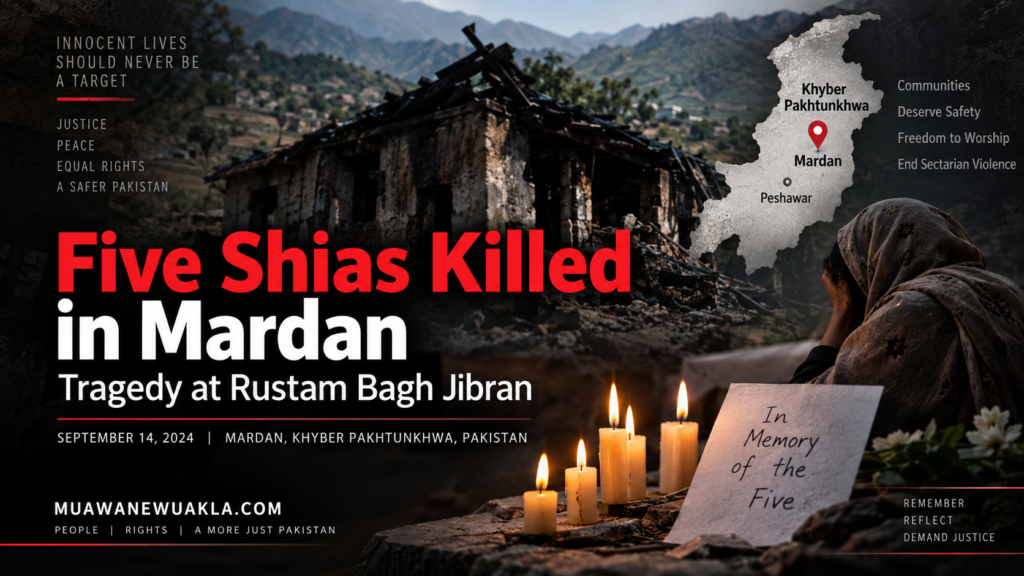
Memorial-style graphic about the deaths of five Shia people in Rustam Bagh Jibran, Mardan, on September 14, 2024.

September 14, 2024 | Rustam Bagh Jibran, Mardan, Khyber Pakhtunkhwa
Five people from a Shia family were killed in a devastating incident in Rustam Bagh Jibran, in Mardan district, on September 14, 2024.
Initial reports described the incident as a deadly fire in a mud house located on a mountain near a shrine. Rescue officials said five people, including women, died in the blaze. The house was reportedly being used as accommodation by devotees visiting the nearby shrine.
Days later, however, the incident took a much more disturbing turn.
According to the South Asia Terrorism Portal, Islamic State Khorasan Province (ISKP) claimed responsibility on September 18 for killing five Shia people in the area.
That claim raises serious questions about what actually happened that night.
What Happened in Rustam Bagh Jibran?
The incident occurred in a remote, mountainous area of Rustam in Mardan.
According to the initial reports, a fire broke out in a mud-built house where devotees of a nearby shrine were staying. Firefighters faced difficulties reaching the location because of the house’s position on the mountain.
All five people inside the building died.
At the time, authorities had not publicly established the cause of the fire.
The subsequent ISKP claim introduced another possible explanation and led terrorism-monitoring organizations to record the incident as an attack against Shia civilians.
ISKP Claimed Responsibility
The later claim by Islamic State Khorasan Province is significant because ISKP has repeatedly targeted Shia communities in the region.
However, a responsible account must make the distinction clear: the initial Pakistani reporting described a fire and said its cause was unknown, while the later ISKP claim attributed the deaths to an attack.
The available sources do not provide enough independently verified evidence to conclusively establish every detail of how the five people died.
That uncertainty should not be ignored.
It is precisely why a full investigation matters.
Five Lives Lost
Regardless of the competing accounts surrounding the incident, five people lost their lives.
The victims were reportedly members of the same family and included women. Their deaths left relatives and a local community grieving.
For Shia families living in areas where sectarian militant groups operate, such incidents can create a lasting sense of fear.
People should be able to visit a shrine, worship, travel and live with their families without worrying that their religious identity could make them a target.
The Broader Threat to Shia Communities
The Mardan incident occurred against the background of continuing sectarian violence in Pakistan.
Organizations such as ISKP have openly targeted Shia communities, while Pakistan has also faced a much longer history of sectarian militancy.
But it is important not to confuse extremist organizations with entire religious communities.
Ordinary Sunni Muslims are not responsible for the actions of militant groups.
The responsibility belongs to those who promote or carry out violence.
Pakistan’s challenge is to confront extremist organizations while protecting every citizen regardless of sect or religious identity.
Why Investigation Matters
The conflicting accounts surrounding this incident make an independent and credible investigation particularly important.
If the fire was deliberately caused, those responsible should be identified and prosecuted.
If an extremist organization was responsible, investigators should establish the evidence linking the perpetrators to that organization.
And if the original explanation of an accidental fire is supported by evidence, that should also be made clear.
Families deserve facts—not rumors, political narratives or unanswered questions.
A Human Rights Perspective
For me, incidents involving the killing of Shia civilians are not simply statistics.
Every victim represents a family that lost someone.
The Hazara community under threat is another example of how repeated violence can affect an entire community and its sense of security.
Freedom to speak about such violence is equally important. Our coverage of freedom of expression in Pakistan examines the challenges faced by people who raise difficult questions about human rights and accountability.
Communities must also be able to peacefully demand justice. Read our report on freedom of peaceful assembly in Pakistan for more on that fundamental right.
Five People Should Not Become Just a Number
The five people who died in Rustam Bagh Jibran deserve to be remembered as human beings, not simply as another entry in a terrorism database.
Whether the deaths resulted from an accidental fire, deliberate violence or an attack claimed by a militant organization, the central responsibility remains the same:
The truth must be established, the victims must be remembered and those responsible for any deliberate violence must face justice.
Pakistan cannot defeat sectarian violence by allowing attacks on religious minorities to disappear from public memory.
Every life matters. Every victim deserves justice.
About the Author
Qundeel Hassan is a journalist and human-rights activist covering Pakistan, minority rights, sectarian violence, freedom of expression and justice.