Shia Rickshaw Driver Hussian Hazara Killed in Quetta Targeted Attack
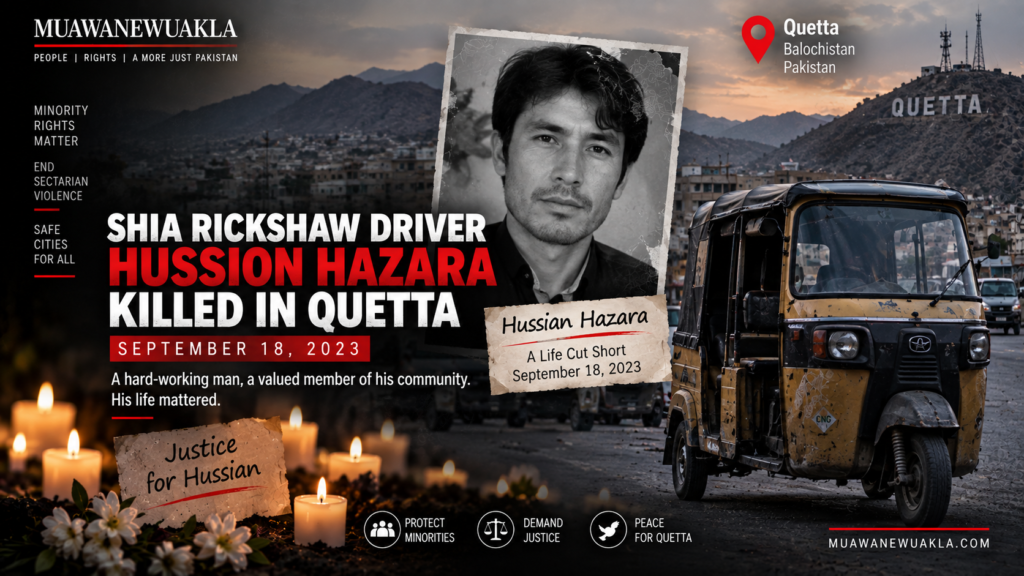
Hussian Hazara, a Shia rickshaw driver, was killed in an apparent targeted attack in Quetta on September 18, 2023.

September 18, 2023 | Quetta, Balochistan, Pakistan
A Hazara Shia rickshaw driver, identified as Hussian Hazara, was shot dead on Alamdar Road in Quetta on September 18, 2023, in what police described as an apparent targeted killing.
The killing once again highlighted the insecurity faced by members of the Hazara Shia community in Quetta, where sectarian violence has repeatedly threatened ordinary people simply trying to work, travel and live their daily lives.
According to reporting by Dawn, Hussian Hazara was a resident of Marriabad. Police said a man hired his rickshaw and travelled with him toward the Alamdar Road area. After reaching the destination, the passenger allegedly pulled out a weapon and opened fire on the driver.
Hussian suffered multiple bullet wounds and died at the scene. Police later shifted his body to Civil Hospital Quetta before handing it over to his family.
Hussian Hazara Was Simply Doing His Job
The circumstances of Hussian Hazara’s death make the incident particularly disturbing.
He was not reported to have been involved in any armed activity or political confrontation. He was a rickshaw driver earning a living when a passenger allegedly used the journey as an opportunity to kill him.
Police described the murder as appearing to be a case of targeted killing. The attacker escaped after the shooting, according to the initial reporting.
For the Hazara Shia community, such incidents carry a painful history. Ordinary workers, shopkeepers, students, professionals and religious figures have repeatedly faced violence in Quetta.
The killing of Hussian Hazara therefore cannot be viewed only as another crime story. It raises a larger question about whether vulnerable communities can live and work without fear.
A Community Living Under the Shadow of Sectarian Violence
Quetta’s Hazara Shia population has endured years of sectarian attacks and targeted killings.
The South Asia Terrorism Portal records Hussian Hazara’s killing among attacks against the Hazara Shia community in Balochistan in 2023.
The history of violence has affected everyday life. When a person cannot confidently travel to work, operate a vehicle, open a shop or move through a city without worrying about being identified and attacked because of their sectarian identity, the problem goes far beyond an individual criminal case.
It becomes a question of the right to life, freedom of movement and equal protection under the law.
Muawanewuakla has previously documented the broader threat facing the Hazara community in Pakistan in our report on Hazara community under threat: targeted killings and the right to life in Pakistan.
The Need for Justice
The most important question following a targeted killing is not only what happened, but whether the perpetrators are identified, arrested and prosecuted.
In Hussian Hazara’s case, the initial reports stated that the attacker escaped from the area.
That is precisely why investigations into sectarian killings must be thorough and transparent. Families who lose loved ones deserve more than condolences. They deserve answers and justice.
Authorities must investigate the circumstances of the attack, identify the perpetrator and establish the motive through evidence. Where sectarian hatred is established, it should be treated with the seriousness that such crimes demand.
Sectarian Violence Must Not Become Normal
Hussian Hazara’s killing should not disappear from public memory simply because it was one incident among many.
Every targeted killing leaves behind a family dealing with grief, fear and financial uncertainty. It also sends a message to an entire community that ordinary life can be interrupted by violence at any moment.
Pakistan’s Constitution guarantees equality and protection of citizens. The state therefore has a responsibility to ensure that religious minorities and vulnerable communities can live without discrimination and fear.
The answer to sectarian violence cannot be silence. It must be accountability, effective policing, prosecution and protection of citizens.
The same principle applies to freedom of expression and peaceful civic activity. Muawanewuakla has also covered freedom of expression in Pakistan and the pressure facing dissent and the right to peaceful assembly in Pakistan.
Remembering Hussian Hazara
Hussian Hazara’s story is ultimately about an ordinary man who went to work and never returned home.
His death deserves to be remembered not simply as another statistic in Pakistan’s long history of sectarian violence, but as the loss of a human being whose family and community had the right to see him return safely.
Targeted violence against Shia Muslims, Hazara families or any other community should never be accepted as normal.
Justice for victims must mean identifying perpetrators, prosecuting those responsible and creating conditions in which no family has to fear losing a loved one simply because of their identity.
Source
The primary contemporary report for the incident is Dawn’s September 19, 2023 report. The incident is also recorded by South Asia Terrorism Portal (SATP) as an attack against the Hazara Shia community in Quetta.
About the Author
This report was written by Qundeel Hassan, Senior Journalist and Human Rights Activist at Muawanewuakla. His reporting focuses on human rights, sectarian violence, minority rights, freedom of expression, justice and attacks against vulnerable communities in Pakistan.
Read more of his reporting on the Qundeel Hassan author page.