Hazara Shia Rickshaw Driver Killed in Quetta Targeted Attack
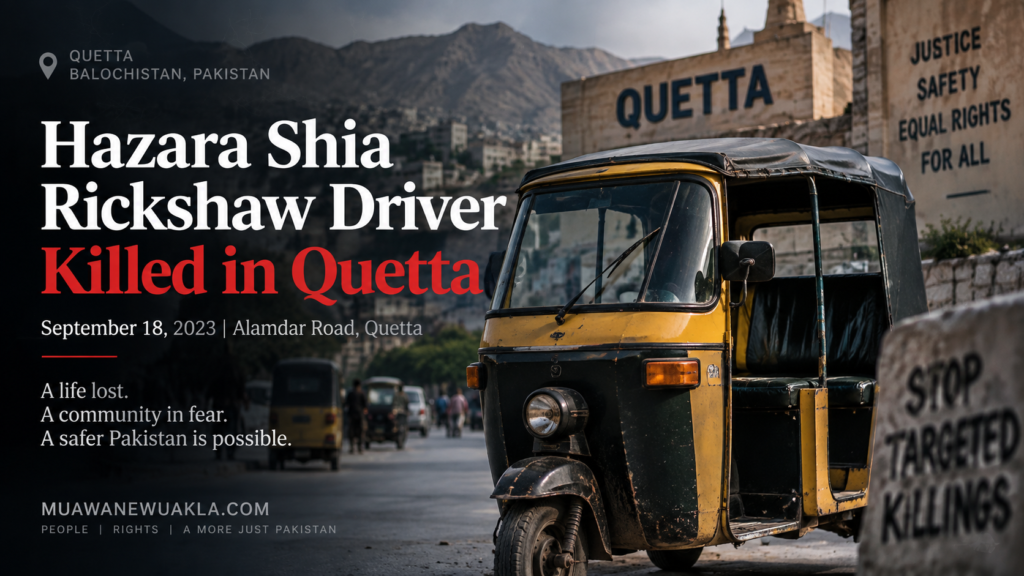
A memorial-style graphic about the September 18, 2023 killing of a Hazara Shia rickshaw driver in Quetta.

September 18, 2023 | Alamdar Road, Quetta, Balochistan
A Hazara Shia rickshaw driver was shot dead in Quetta on September 18, 2023, in what police described as an apparent targeted killing.
The victim, identified as Hussian Hazara, was reportedly driving his rickshaw when a passenger opened fire on him near Alamdar Road. He suffered multiple gunshot wounds and died at the scene, while the attacker escaped.
For the Hazara community, the killing was another painful reminder of the insecurity that has affected their lives in Quetta for years.
Hussian Hazara Was Killed While Working
Hussian was reportedly carrying out his ordinary work as a rickshaw driver when the attack happened.
According to police, the passenger who had hired the rickshaw allegedly opened fire after reaching the Alamdar Road area. Police described the circumstances as an apparent targeted killing, although the identity of the attacker and the precise motive were not immediately established.
For an ordinary worker simply trying to earn a living, the attack represents a devastating loss—not only for his family but also for a community that has repeatedly faced violence.
Hazara Shias and the Threat of Targeted Violence
The Hazara Shia community in Quetta has experienced years of targeted violence and insecurity.
The September 18 killing was recorded by the South Asia Terrorism Portal among incidents involving attacks against Shias in Pakistan during 2023.
Our report on Hazara community under threat examines the wider threat facing the community and the fundamental right to life and security.
These incidents raise a serious question:
How can people live normal lives when their identity can potentially make them a target?
Justice Must Mean More Than an Investigation
Every targeted killing deserves a serious investigation.
The family of Hussian Hazara deserved answers about who carried out the attack, why he was targeted and whether those responsible would eventually face justice.
Simply registering a case is not enough.
Authorities must investigate attacks effectively, identify perpetrators and ensure that cases are pursued through the justice system.
At the same time, vulnerable communities need meaningful protection—not only after an attack but before one occurs.
Why Reporting These Killings Matters
Sectarian violence can quickly disappear from national attention when another crisis dominates the headlines.
That is why journalists have an important responsibility to document these incidents and keep the experiences of affected families in the public record.
Our coverage of freedom of expression in Pakistan explores why the ability of journalists and citizens to report concerns, question authorities and speak about human-rights violations is so important.
The right to peaceful protest is equally important when communities demand justice. Our article on freedom of peaceful assembly in Pakistan looks at those rights and the legal challenges surrounding them.
A Human Rights Perspective
Hussian Hazara should not be remembered simply as another number in a violence statistic.
He was a worker, a family member and a human being who deserved to go to work and return home safely.
No Pakistani should be targeted because of their religious identity.
Protecting minority communities requires more than condemnation after a killing. It requires effective policing, credible investigations, prosecution of perpetrators and long-term protection for vulnerable communities.
The right to life belongs to everyone.
Sectarian violence must never become normal in Pakistan.
About the Author
Qundeel Hassan is a journalist and human-rights activist covering Pakistan, minority rights, freedom of expression, justice and sectarian violence.