Shia Elder Hamid Askar Killed in Kohat Targeted Shooting
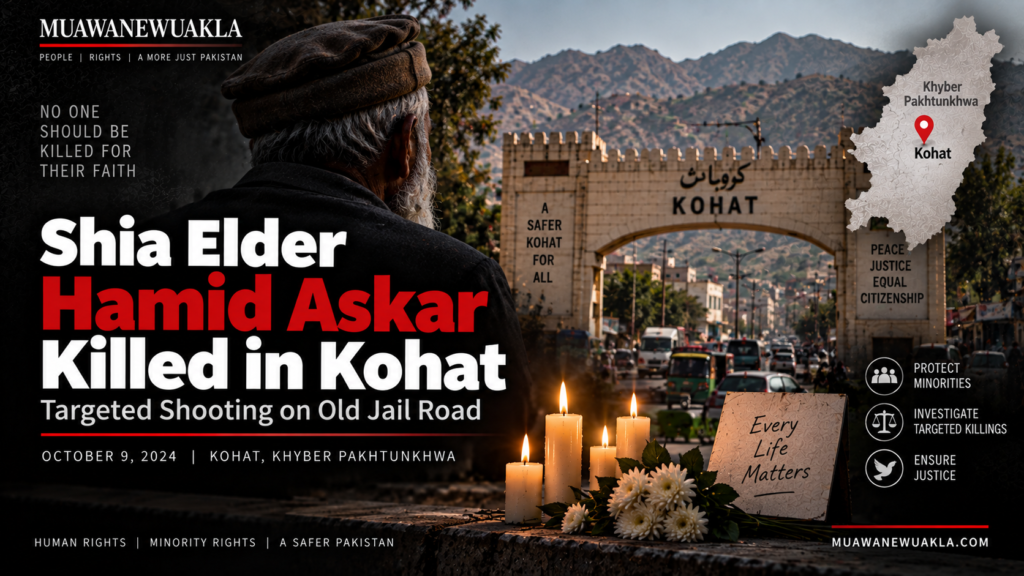
Memorial-style graphic about the killing of Shia elder Hamid Askar in Kohat on October 9, 2024.

October 9, 2024 | Kohat, Khyber Pakhtunkhwa
Hamid Askar, a local Shia elder from Orakzai District, was shot dead by unknown assailants on Old Jail Road in Kohat, Khyber Pakhtunkhwa, on October 9, 2024.
The killing was recorded by the South Asia Terrorism Portal (SATP), which cited The Khorasan Diary for its account of the incident. The available reporting identifies the attackers only as unknown assailants and does not establish the involvement of a particular militant organization.
The death of Hamid Askar adds another name to the record of violence affecting Shia citizens in Khyber Pakhtunkhwa and raises renewed questions about the protection of vulnerable communities.
Hamid Askar Shot Dead on Old Jail Road
According to SATP, Hamid Askar was a local Shia elder from Orakzai District. He was shot dead on Old Jail Road in Kohat District on October 9, 2024.
SATP’s October 10 terrorism update also recorded the killing, placing it among several violent incidents reported across Khyber Pakhtunkhwa on the same day.
Beyond these details, publicly available reporting on the case is limited. The available source does not provide verified information about the identity of the attackers, their motive, or whether suspects were subsequently arrested.
That lack of information makes a proper investigation especially important.
Another Shia Life Lost to Violence
The killing of a community elder is not simply another statistic.
For a family, it means the sudden loss of a loved one. For relatives and friends, it means unanswered questions. For the wider community, it can create another layer of fear around ordinary movement and daily life.
Hamid Askar was identified as a Shia elder from Orakzai. His killing in Kohat is therefore significant for a community that has repeatedly experienced violence and insecurity in parts of Khyber Pakhtunkhwa.
Pakistan’s Shia citizens have the same right to life and security as every other citizen.
That principle should not depend on where a person lives, what sect they belong to or how vulnerable their community may be.
Sectarian Violence in Khyber Pakhtunkhwa
The killing occurred against a broader backdrop of violence affecting Shia communities in Pakistan.
SATP’s 2024 database on attacks against Shias records Hamid Askar’s killing alongside other incidents involving Shia victims during the year. The database also records the November 2024 attack on passenger convoys in Kurram, where at least 44 people were killed and 16 injured; most of the victims were reported to be Shia.
The pattern demonstrates why sectarian violence cannot be treated as an isolated security issue.
For communities repeatedly exposed to attacks, violence affects much more than the immediate victims. It can influence where people travel, where they work, whether families feel safe sending their children to school and whether people feel secure practicing their religion openly.
The same concerns are reflected in our reporting on the Hazara community under threat and targeted killings in Pakistan.
Unknown Assailants Must Be Identified
One of the most important facts surrounding Hamid Askar’s killing is that the available reporting identifies his attackers only as unknown assailants.
Authorities should establish who carried out the shooting and why he was targeted.
A proper investigation should examine:
- Who carried out the shooting?
- What was the motive?
- Was Hamid Askar specifically targeted because of his religious identity?
- Were the attackers acting individually or as part of an organized network?
- Were suspects identified or arrested?
- What measures were taken to prevent similar attacks?
These questions matter because justice cannot be achieved simply by recording that a killing happened.
Families deserve answers, and victims deserve accountability.
Responsibility Must Be Established Through Evidence
Sectarian violence in Pakistan has a long and documented history, and extremist organizations have carried out attacks against religious minorities. But historical patterns should not be confused with proof in an individual case.
In Hamid Askar’s case, the available source does not identify a specific militant organization as responsible.
Therefore, attributing his killing to SSP, Lashkar-e-Jhangvi, TTP, ISKP or another organization without evidence would be irresponsible journalism.
The objective should be clear: identify the perpetrators through investigation and hold those responsible accountable under the law.
The Right of Shia Citizens to Live Without Fear
As a journalist and human-rights activist, I believe documenting sectarian killings is important because individual victims can easily disappear from public memory once the immediate news cycle ends.
Hamid Askar should not become merely another name in a database.
He was a member of a community, a relative and a human being whose life had value.
The freedom of expression and protection of dissent in Pakistan are also important to documenting these cases openly. Human-rights reporting gives victims and their families a public record when violence might otherwise be forgotten.
At the same time, condemning sectarian extremism should never mean blaming an entire religious community. Responsibility belongs to the individuals and organizations that commit, facilitate or encourage violence.
Justice Must Apply Equally
Pakistan cannot build lasting peace while targeted killings remain unresolved.
The state has a responsibility to protect citizens regardless of sect, ethnicity or background. That means preventing attacks, investigating killings, prosecuting suspects through due process and providing protection to communities facing credible threats.
The killing of Hamid Askar deserves more than a brief entry in an incident database.
It deserves investigation, accountability and remembrance.
For Shia citizens in Kohat, Orakzai and across Pakistan, the message should be simple:
Their lives matter. Their rights matter. And they deserve the same protection under the law as every other Pakistani citizen.
About the Reporter
This report was written by Qundeel Hassan, Senior Journalist and Human Rights Activist at Muawanewuakla.
Qundeel Hassan covers human rights, sectarian violence, minority rights, freedom of expression, justice and attacks against vulnerable communities in Pakistan.
Read more of his reporting on the Qundeel Hassan author page.
For related coverage, readers can also explore our reporting on freedom of peaceful assembly in Pakistan and the broader protection of minority communities.