Lebanon: The Killing of Journalist Amal Khalil and the Safety of Journalists in Conflict
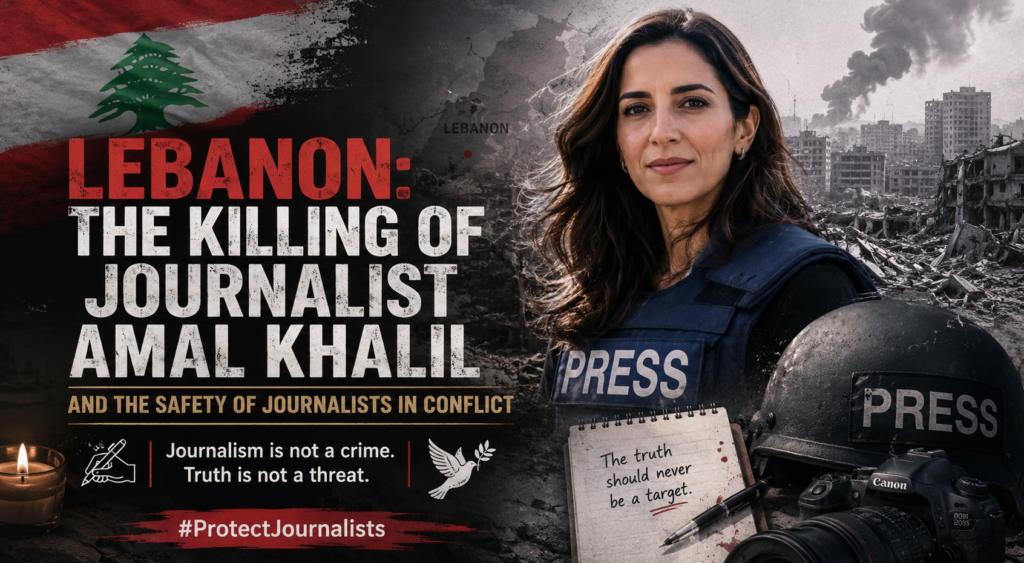
The killing of journalist Amal Khalil highlights the dangers faced by journalists covering conflict and the urgent need to protect press freedom.

Introduction
Freedom of the press is a fundamental human right. Journalists play an essential role in conflicts because they document events, inform the public, and provide evidence of violations that might otherwise remain hidden. Yet reporting from a war zone can place journalists in extreme danger.
The killing of Lebanese journalist Amal Khalil in southern Lebanon on April 22, 2026, has raised serious concerns about the protection of journalists and civilians during armed conflict. Khalil, a veteran reporter for the Lebanese newspaper Al-Akhbar, was covering hostilities in southern Lebanon when she was killed in an Israeli strike in the village of al-Tiri. Her colleague, journalist and camerawoman Zeinab Faraj, was seriously injured.
In August 2026, Human Rights Watch, Amnesty International and the Lebanese organization The Legal Agenda published investigations concluding that the circumstances of the attack warranted investigation as a possible war crime. The findings have renewed international calls for accountability and stronger protection for journalists working in conflict zones.
Who Was Amal Khalil?
Amal Khalil was an experienced Lebanese journalist who had spent many years reporting from southern Lebanon. She covered conflict and its effects on local communities, including destruction, displacement and the experiences of civilians living in areas affected by fighting.
According to Reporters Without Borders, Khalil had continued reporting from southern Lebanon despite the dangers faced by journalists in the region. Her work demonstrated the important role of local journalists who remain close to affected communities and report events from the ground.
Her death was therefore not only a personal tragedy for her family and colleagues. It also highlighted the risks faced by journalists who attempt to document armed conflicts.
What Happened on April 22, 2026?
On April 22, Khalil and Zeinab Faraj were reporting in the southern Lebanese town of al-Tiri. According to investigations by Human Rights Watch and other organizations, an initial strike hit a vehicle near the journalists, killing two people. Khalil and Faraj then sought shelter in a nearby building.
A later strike hit the building where the journalists were sheltering. Khalil became trapped beneath the rubble, while Faraj was seriously wounded. Human Rights Watch reported that a Lebanese Red Cross request to access the site had been communicated through the United Nations Interim Force in Lebanon (UNIFIL). Rescue efforts were nevertheless delayed. Khalil was eventually found dead beneath the rubble.
The circumstances surrounding the attack have become a major human-rights concern because of questions about whether the journalists were identifiable as civilians and whether sufficient measures were taken to protect them.
Why Human Rights Organizations Called for an Investigation
Human Rights Watch said that evidence including photographs, videos, witness accounts and communications concerning the rescue effort indicated that the journalists were civilians and that the circumstances of the attack required investigation as a possible war crime. Amnesty International similarly called for the attack to be investigated as a war crime.
The Israeli military has maintained that it does not target journalists and said that its forces were targeting Hezbollah-related individuals. This makes an independent investigation particularly important: allegations concerning unlawful attacks on civilians should be assessed through credible evidence and appropriate legal mechanisms rather than through competing political claims.
The Committee to Protect Journalists has also renewed its call for accountability, arguing that the killing must not remain unpunished.
Journalists Are Civilians Under International Law
International humanitarian law gives journalists who are civilians protection from direct attack, provided they do not take part in hostilities. Their profession does not make them legitimate military targets.
This protection is particularly important during war. Journalists may report from areas where military forces operate, but their purpose is to gather and communicate information rather than participate in fighting.
When journalists are attacked, the consequences extend beyond the individual victim. The public can lose access to independent information, while evidence of human-rights abuses and violations of international law can disappear.
The Wider Problem of Journalist Safety
Amal Khalil’s death is part of a broader problem facing journalists around the world. Reporters working in conflict zones can face airstrikes, gunfire, detention, threats, harassment, kidnapping and restrictions on movement.
Local journalists are particularly vulnerable because they often remain in conflict-affected areas long after international correspondents have left. They may also have fewer resources, less access to protective equipment and limited opportunities to evacuate.
The situation demonstrates that protecting journalists requires more than simply recognizing freedom of expression. Journalists need practical protection, safe access to medical assistance, respect for their civilian status and effective investigations when attacks occur.
The Human Rights Dimension
The killing of Amal Khalil raises several important human-rights questions:
- Right to Life
The right to life is one of the most fundamental human rights. Any allegation that civilians were unlawfully killed during an armed conflict requires serious investigation.
- Freedom of Expression
Journalists exercise freedom of expression by reporting information to society. When journalists are killed or threatened, the wider public’s right to receive information is also affected.
- . Protection of Civilians
Journalists who are civilians are protected under international humanitarian law. Parties to a conflict must distinguish between civilians and legitimate military targets.
- Access to Emergency Medical Assistance
The delay in reaching Khalil after she became trapped under rubble has raised additional concerns. In armed conflicts, wounded people and those in need of urgent medical assistance should be treated humanely, and humanitarian rescue operations should be respected.
- Accountability
When journalists are killed unlawfully, investigations must be independent, effective and transparent. Without accountability, attacks can create a culture of impunity and encourage further violations
What Should Be Done?
Governments, armed forces and international organizations should take stronger measures to protect journalists working in conflict areas.
First, journalists must be clearly recognized as civilians when they are not participating in hostilities.
Second, attacks involving journalists should be independently investigated. If evidence establishes criminal responsibility, those responsible should face appropriate legal consequences.
Third, rescue and medical teams must be allowed to reach wounded civilians and journalists without unnecessary obstruction.
Fourth, media organizations should provide journalists with appropriate safety training, protective equipment, emergency communication systems and evacuation plans.
Finally, international organizations should continue monitoring attacks against journalists and publicly document cases so that evidence is preserved and accountability remains possible.
Conclusion
The killing of Amal Khalil is a painful reminder that journalism can come at an extraordinary human cost during war. Her death, and the serious injury suffered by Zeinab Faraj, demonstrate the dangers faced by journalists who work to document conflicts from the ground.
The recent investigations by Human Rights Watch, Amnesty International and The Legal Agenda have intensified calls for an independent investigation into the circumstances of the attack.
Protecting journalists is not simply about protecting a profession. It is about protecting freedom of expression, the public’s right to information, civilian life and accountability for violations of human rights and international humanitarian law.
Amal Khalil’s story should therefore not end with her death. It should strengthen the international commitment to ensuring that journalists can report from conflict zones without becoming targets—and that when journalists are killed, credible investigations and justice follow.
References
- Amnesty International. Lebanon: Deadly Israeli attack on journalist Amal Khalil must be investigated as a war crime. August 2026.
- Human Rights Watch. Lebanon: Israel’s Killing of Journalist an Apparent War Crime. August 6, 2026.
- Committee to Protect Journalists. CPJ renews accountability calls in the killing of Lebanese journalist Amal Khalil. August 6, 2026.
- Reporters Without Borders. Journalist Amal Khalil killed by Israeli airstrikes in Lebanon. April 23, 2026.
- Al Jazeera. Rights groups call Israel’s killing of journalist Amal Khalil a ‘war crime’. August 6, 2026.