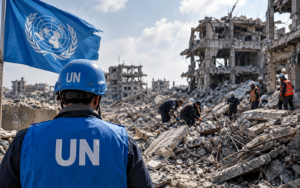
Human Rights in Afghanistan: Detention of UN and NGO Workers
By Qundeel Hassan
Senior Journalist & Human Rights Activist
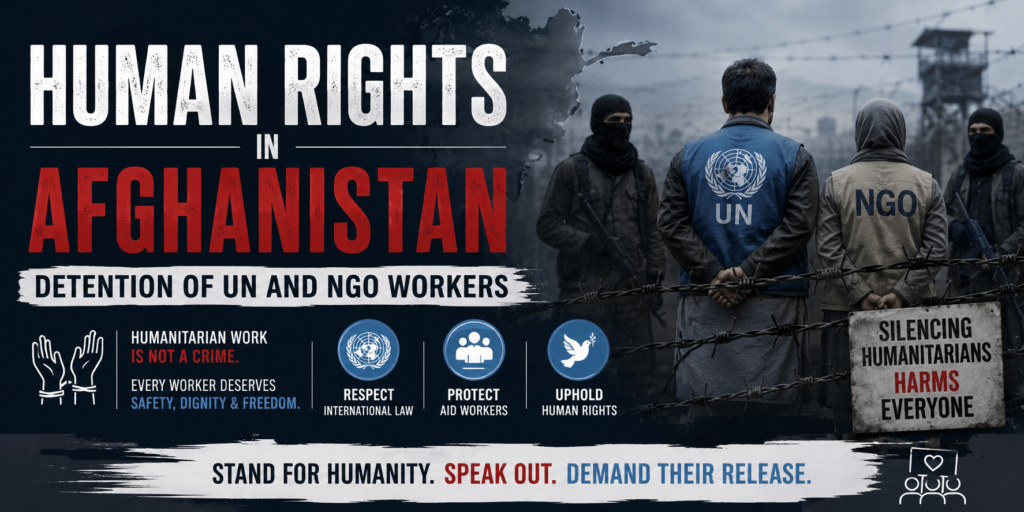
Introduction
Human rights are the basic freedoms and protections that every person should enjoy, regardless of nationality, gender, religion, profession, or political opinion. In Afghanistan, the human rights situation has remained a serious international concern since the Taliban returned to power in August 2021. Recent arrests of United Nations (UN) personnel and humanitarian workers have added a new dimension to these concerns.
In August 2026, the UN reported that two Afghan employees of the United Nations Assistance Mission in Afghanistan (UNAMA) had been detained by Taliban authorities in Herat. The UN said that its representatives had not been given access to the detained staff members and that no formal charges had been provided.
At the same time, Human Rights Watch reported that six employees of the Women and Children Legal Research Foundation (WCLRF), an Afghan organization working on women’s and children’s rights, had also been detained. According to the report, the workers were taken into custody on July 18, 2026, and their families had not received clear information about their condition or charges.
What Happened?
The recent detentions have raised serious questions about the safety and independence of humanitarian and human rights organizations operating in Afghanistan.
According to Human Rights Watch, Taliban forces raided the Kabul office of WCLRF on June 21, confiscated belongings, and later summoned six male employees. The organization says the employees were subsequently detained. Their reported detention is particularly significant because WCLRF works to protect women and children—groups that already face severe restrictions in Afghanistan.
Separately, two Afghan employees of UNAMA were detained in Herat by Taliban intelligence officials on August 9, 2026, according to reports. The United Nations has called for respect for the rights and immunities of its personnel and for access to the detained employees.
The Taliban authorities have said that investigations are ongoing, but publicly available information has not established clear charges against the detained workers
Human Rights Issues Involved
1-Right to Liberty and Security
International human rights principles protect individuals from arbitrary arrest and detention. When people are detained without clear charges, judicial oversight, or information about their whereabouts, concerns arise about arbitrary detention.
UNAMA itself has emphasized that the rights of detained people and due process should be respected.
2-Right to Due Process
A person who is arrested should be informed of the reason for the arrest and should have access to appropriate legal procedures. The reported lack of information about charges against the UN and NGO workers raises concerns about whether basic due-process protections are being respected.
3-Protection of Humanitarian Workers
Humanitarian organizations provide essential assistance to people affected by poverty, displacement, conflict, and other emergencies. Afghanistan continues to depend heavily on humanitarian assistance.
A UN report covering January to March 2026 recorded 307 humanitarian-access incidents, including the detention of 12 humanitarian staff members, one of whom was a UN staff member. These incidents temporarily suspended 242 humanitarian activities.
This demonstrates that restrictions and arrests do not only affect aid workers themselves. They can also affect millions of ordinary Afghans who depend on humanitarian services.
4-Freedom of Association
NGOs and civil society organizations play an important role in protecting human rights. Their workers should be able to carry out legitimate humanitarian and human rights activities without intimidation, arbitrary detention, or retaliation.
When NGO workers are detained, other organizations may become afraid to continue their work, potentially reducing humanitarian assistance and human rights monitoring.
5-Women’s and Children’s Rights
The WCLRF case is particularly important because the organization works on women’s and children’s rights. Afghanistan’s women and girls already face extensive restrictions.
UN reporting continues to document serious restrictions on women’s education, employment, movement, and participation in public life.
UNESCO reported in August 2026 that approximately 2.4 million Afghan girls remain excluded from secondary education, making Afghanistan the only country where girls are formally prohibited from secondary and higher education.
The detention of people working to protect women and children therefore raises broader concerns about the ability of civil society to defend vulnerable groups.
Impact on Humanitarian Work
Afghanistan faces significant humanitarian and economic challenges. Humanitarian organizations provide food, health services, education, protection, and other forms of assistance to vulnerable communities.
If humanitarian workers are arrested or organizations face restrictions, aid operations can be delayed or suspended. The UN has already documented hundreds of humanitarian-access incidents in 2026.
Fear among humanitarian workers can also make organizations less willing to operate in areas where they face security or political pressure. This can ultimately hurt civilians who have no connection to political disputes.
International Response
The United Nations has called for respect for the rights and privileges of its personnel and has sought access to the detained UN employees. Human Rights Watch has urged the Taliban authorities to release the detained workers or provide legitimate legal charges and due process.
The international community faces a difficult challenge: humanitarian organizations must continue helping Afghan civilians while also demanding respect for fundamental human rights and international standards.
UNAMA continues to monitor human rights conditions in Afghanistan and publishes regular reports documenting violations and recommendations for improving human rights protection.
Why This Matters
The detention of UN and NGO workers is not simply an issue involving a small number of individuals. It raises larger questions about the rule of law, freedom of association, humanitarian access, and the protection of human rights in Afghanistan.
Humanitarian workers are often among the people providing assistance to communities suffering from poverty, displacement, illness, and conflict. Protecting them helps protect the civilians they serve.
At the same time, civil society organizations are important for documenting human rights violations and supporting people whose rights are threatened. Restricting their activities can make it more difficult for abuses to be reported and addressed
Recommendations
Several steps could help improve the situation:
- Release individuals who are being detained without lawful charges.
- Provide detained people with clear information about the reasons for their detention.
- Guarantee access to legal representation and fair judicial procedures.
- Allow UN and humanitarian organizations to operate safely and independently
- Protect humanitarian workers from intimidation, arbitrary detention, and retaliation.
- Ensure that women and children can access organizations and services designed to protect their rights.
- Maintain international monitoring of human rights conditions in Afghanistan.
- Ensure that humanitarian concerns do not become secondary to political disputes.
Conclusion
The reported detention of UN and NGO workers in Afghanistan is a serious human rights concern. The cases involving two UN employees and six workers from a women’s and children’s rights organization demonstrate the risks faced by people working to provide assistance and defend human rights.
Respect for human rights requires more than preventing physical harm. It also requires due process, protection from arbitrary detention, freedom to perform legitimate humanitarian work, and access to justice.
Afghanistan’s humanitarian crisis makes the work of UN agencies and NGOs especially important. Protecting humanitarian and human rights workers is therefore not only a matter of protecting individual employees—it is essential for protecting the rights and well-being of the Afghan population as a whole
References
- United Nations Assistance Mission in Afghanistan (UNAMA), Human Rights Monitoring and Reporting.
- United Nations, Human Rights Situation in Afghanistan: January–March 2026.
- United Nations, Report on humanitarian access and incidents in Afghanistan.
- Reuters, Human Rights Watch urges Taliban to release detained UN, NGO staff, August 13, 2026.
- Associated Press, reports on the detention of UN and NGO workers in Afghanistan, August 2026.