Karachi Christian Family Blasphemy Case: Mob Threat Raises Human Rights Concerns
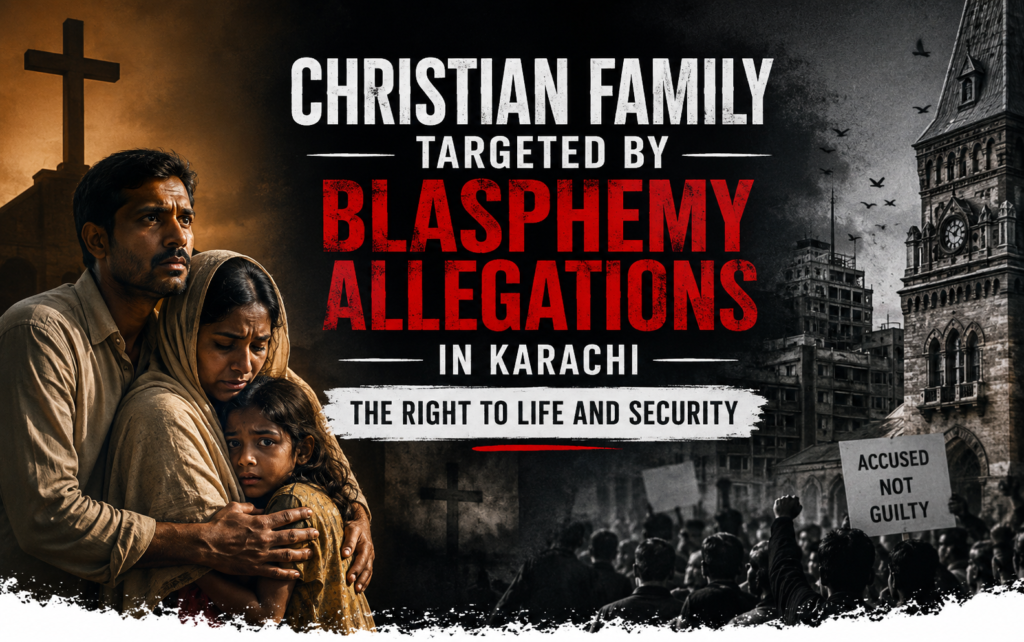
A Karachi Christian family faces threats following a blasphemy allegation, raising concerns about minority rights, security and justice.

Qundeel Hassan
KARACHI, July 2026 — A Christian family in Karachi faced a serious threat after an allegation of Quran desecration reportedly triggered a large crowd outside their home. Police intervened to protect the family, while an initial inquiry reportedly found the allegations to be false.
The incident has renewed concerns about blasphemy allegations in Pakistan, mob violence, Christian minority rights, religious freedom, due process and the right to life.
According to reports, the family included four women and a child. The situation became dangerous as a crowd gathered near the family’s residence, prompting police to intervene and prevent the confrontation from turning into a deadly attack.
The incident highlights a wider human-rights concern: an unproven accusation can sometimes place an entire family at immediate risk before authorities have established the facts.
What Happened to the Christian Family in Karachi?
The incident reportedly began after allegations of Quran desecration were made against a Christian family in Karachi.
As the accusation spread, a large crowd gathered outside or near the family’s home. Police officers intervened and worked to prevent violence.
According to Reuters reporting cited in coverage of the incident, police eventually protected the family and prevented the situation from escalating. An initial police inquiry reportedly concluded that the allegations were false.
The case demonstrates why allegations involving religion require careful investigation rather than immediate punishment.
An accusation is not the same as proof.
Criminal responsibility should be established through evidence and the legal process.
Why Blasphemy Allegations Can Be Dangerous in Pakistan
Blasphemy is an extremely sensitive issue in Pakistan, and accusations can have serious consequences even before a case reaches court.
In some cases, individuals accused of blasphemy have faced threats, intimidation, displacement and mob violence.
Human Rights Watch has previously documented concerns that Pakistan’s blasphemy laws can be misused for purposes including blackmail, unlawful evictions and land disputes, with religious minorities particularly vulnerable.
The danger is therefore not limited to whether an allegation ultimately results in a conviction.
The allegation itself can become a threat to someone’s safety.
The Right to Life and Personal Security
The right to life is one of the most fundamental principles of human rights.
Every person should be protected from unlawful killing and violence regardless of their religion, ethnicity or social status.
The right to personal security is equally important.
When a crowd gathers outside someone’s home because of an allegation, the family may reasonably fear for their lives even before any formal legal proceedings begin.
The Karachi case demonstrates why authorities must respond rapidly when there is a credible risk of mob violence.
Christian Minority Rights in Pakistan
Pakistan is home to religious minorities including Christians, Hindus, Sikhs and others.
Christian citizens have the same fundamental right to protection from violence, intimidation and discrimination.
The reported Karachi incident is particularly significant because it involved a Christian family allegedly targeted because of a religious accusation.
The United Kingdom’s July 2026 country information on Christians in Pakistan has documented concerns surrounding blasphemy accusations, discrimination and violence affecting Christian communities.
Protecting religious minorities is therefore an important part of protecting human rights and equality before the law in Pakistan.
False or Unproven Allegations Can Put Families at Risk
A false or unproven blasphemy allegation can have consequences far beyond the original accusation.
Potential consequences can include:
- Threats against family members
- Mob violence
- Damage to homes and property
- Forced displacement
- Loss of employment
- Disruption to children’s education
- Psychological trauma
- Social isolation
- Fear of returning home
This is why allegations must be handled by competent authorities.
Rumors, social-media posts and accusations should never determine a person’s guilt or innocence.
Mob Justice Cannot Replace the Legal System
The Karachi Christian family case also highlights the importance of the rule of law.
In a functioning justice system, an allegation should be investigated, evidence should be collected and the courts should determine criminal responsibility.
A crowd cannot replace a court.
Mob justice creates the possibility that an innocent person could be seriously injured or killed before the facts have even been established.
The role of police is therefore crucial when an accusation begins attracting a crowd.
Police Intervention Prevented a Potential Tragedy
Police intervention reportedly prevented the situation in Karachi from becoming a deadly attack.
Authorities moved to protect the family and disperse the crowd rather than allowing individuals to take the law into their own hands.
This is an important principle for protecting religious minorities and other vulnerable communities.
When credible threats emerge, law-enforcement authorities should prioritize the immediate protection of human life while ensuring that any underlying allegation is investigated according to law.
The Role of Interfaith Solidarity
Preventing religious violence requires cooperation across communities.
Muslim and Christian religious leaders, police officers, civil-society organizations, journalists and ordinary citizens can all play a role in preventing mob violence.
When community leaders encourage people to remain peaceful and allow authorities to investigate allegations, they can help prevent an accusation from turning into violence.
The Karachi incident demonstrates the importance of interfaith solidarity in Pakistan.
Protecting one vulnerable family ultimately strengthens the principle that every community deserves protection.
Religious Freedom and Human Rights in Pakistan
The case also raises broader questions about religious freedom in Pakistan.
Religious freedom requires more than the ability to practise one’s faith. It also requires protection from violence and intimidation because of religious identity.
A Christian family should be able to live safely in its community without fearing that an accusation could lead to a mob outside its home.
Similarly, people of every religion should be protected from violence when allegations are made against them.
What Should Pakistan Do to Prevent Mob Violence?
Several measures could help protect people accused of blasphemy and prevent allegations from escalating into violence.
Immediate police protection
Authorities should quickly assess threats and protect individuals and families when there is a credible risk of mob violence.
Evidence-based investigations
Allegations should be investigated carefully, with evidence examined by competent authorities.
Accountability for violence
Individuals who commit violence, threaten families or destroy property should face appropriate legal proceedings.
Protection for religious minorities
Minority families facing credible threats should have access to effective state protection.
Countering misinformation
Unverified allegations should not be allowed to spread unchecked, particularly when they could put someone’s life at risk.
Interfaith cooperation
Religious and community leaders should continue promoting peaceful dialogue and respect for the rule of law.
Why the Karachi Christian Family Case Matters
The Karachi Christian family blasphemy case is important because it demonstrates how quickly a religious accusation can become a human-rights emergency.
The family reportedly faced a large crowd despite the allegations later being found false during an initial inquiry.
Had authorities failed to intervene, the consequences could have been much more serious.
The case therefore provides an important lesson for Pakistan: protecting human life must come before mob anger or unverified accusations.
A Warning for Christians and Other Religious Minorities
The incident should also prompt broader discussion about the safety of Pakistan’s religious minorities.
Christians, Hindus, Sikhs and other minority communities should be able to seek protection from the state without fear that religious accusations will place their families in danger.
The government and law-enforcement agencies have a responsibility to protect citizens regardless of their religious identity.
Frequently Asked Questions
What happened to the Christian family in Karachi?
A Christian family in Karachi reportedly faced a large crowd after allegations of Quran desecration circulated. Police intervened and protected the family, while an initial inquiry reportedly found the allegations to be false.
Why are blasphemy allegations dangerous in Pakistan?
Blasphemy allegations can create serious security risks because individuals accused of blasphemy may face threats, intimidation or mob violence before their cases are resolved through the legal system.
What are the rights of Christians in Pakistan?
Christians are citizens of Pakistan and are entitled to protection from violence, discrimination and unlawful threats, as well as the protections provided by Pakistani law.
Can a crowd punish someone accused of blasphemy?
No. Allegations should be investigated by the appropriate authorities and criminal responsibility determined through the legal process. Mob violence is not a substitute for judicial proceedings.
Why is the Karachi case important?
The case highlights concerns about Christian minority rights, mob violence, blasphemy allegations, religious freedom, due process and human rights in Pakistan.
Conclusion
The Karachi Christian family blasphemy case highlights the serious dangers that can arise when an unproven religious accusation triggers mob action.
The reported intervention by police helped protect a Christian family from a potentially deadly confrontation, while an initial inquiry reportedly found the allegations to be false.
The incident demonstrates why the right to life, personal security, religious freedom, equality and due process must be protected together.
No allegation should become a justification for mob violence or extrajudicial punishment.
Justice must be determined through evidence, investigation and law—not rumors, anger or crowds.
For Pakistan’s Christian community and other religious minorities, protection from violence is not simply a security concern. It is a fundamental human-rights obligation.