Journalists In Pakistan Face Rising Threats
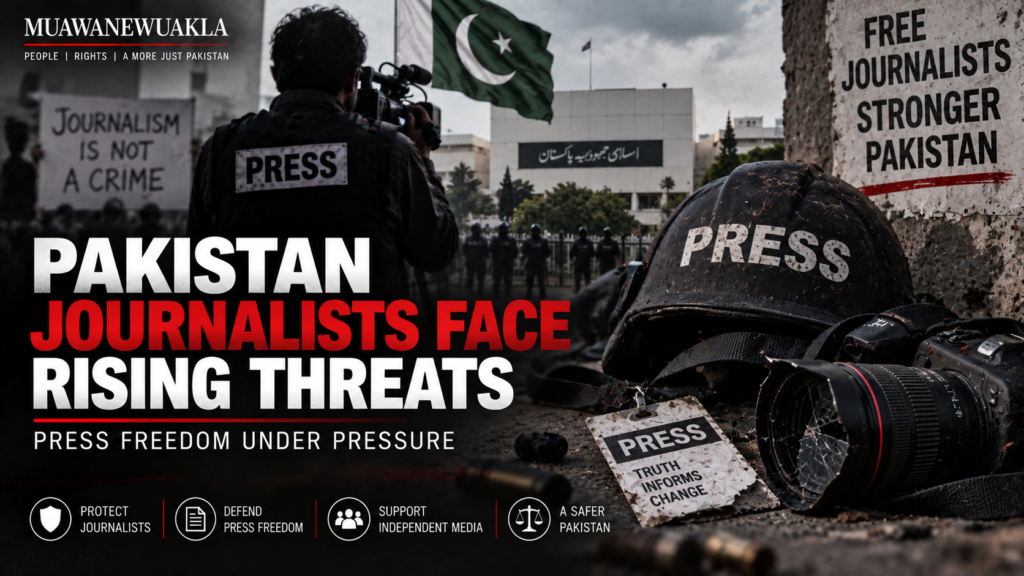
Illustrative news graphic highlighting threats, legal pressure and attacks facing journalists and independent media in Pakistan.

April 2025–August 2026 | Pakistan
Journalism in Pakistan are facing growing pressure as they encounter legal cases, physical attacks, threats, arrests, digital harassment and restrictions on independent reporting.
A recent Freedom Network assessment documented 129 verified violations against journalists between April 2025 and March 2026. The documented cases included two journalist killings, five threats to murder, 58 legal cases, 16 physical assaults, 11 threats to harm, and two cases involving kidnapping or enforced disappearance.
The findings raise serious questions about the safety of journalists and the future of press freedom in Pakistan.
Journalists Facing Increasing Pressure
Journalists play an essential role in informing the public, exposing abuses and holding powerful institutions accountable.
But reporting on sensitive political, security and human-rights issues can carry significant risks in Pakistan.
According to Freedom Network’s assessment, legal intimidation and physical attacks accounted for nearly two-thirds of the verified violations during the review period. Punjab and Khyber Pakhtunkhwa were identified among the most dangerous areas for journalists.
The pressure does not come in one form.
Journalists may face criminal complaints after publishing reports, physical attacks while covering events, online threats, surveillance or pressure to remove content.
This creates an environment in which journalists may begin to censor themselves before publishing stories that could attract official or powerful actors’ attention.
PECA and the Pressure on Online Journalism
One of the major concerns highlighted by press-freedom organizations is the use of Pakistan’s Prevention of Electronic Crimes Act (PECA).
Freedom Network documented 58 legal cases involving journalists, with most reportedly invoking PECA.
The Pakistan Press Foundation has similarly warned about increasing legal pressure, digital harassment and the use of regulatory mechanisms against journalists and media organizations. Its assessment documented 233 instances of violence, threats, legal action, censorship, connectivity problems and related pressure between January 2025 and April 2026.
The concern is not that cybercrime laws should never exist. The concern is whether laws designed to combat genuine online crimes can be applied in ways that discourage legitimate journalism and criticism.
Legal Cases Can Have a Chilling Effect
A journalist does not necessarily have to be imprisoned to be silenced.
A criminal complaint, investigation, summons or threat of prosecution can itself create pressure.
When reporters know that publishing an investigation could lead to legal proceedings, some may choose not to publish the story at all.
That creates a chilling effect on journalism.
Freedom Network’s findings indicate that legal cases have become one of the most significant categories of pressure against journalists.
For an independent journalist, even defending against a legal case can consume significant time and financial resources.
Physical Violence Remains a Serious Threat
Legal pressure is only one part of the problem.
Journalists also continue to face physical attacks and threats.
Freedom Network recorded 16 assaults and five threats to murder during its April 2025–March 2026 reporting period. The same assessment recorded two journalist killings.
The Pakistan Press Foundation’s longer reporting period likewise documented dozens of assaults, arrests, detentions and abductions involving journalists and media workers.
These incidents demonstrate that press freedom is ultimately connected to the physical safety of journalists.
A journalist cannot report freely if reporting itself creates a credible threat to their life.
Journalists and Human Rights Reporting
Human-rights journalists often work on stories involving powerful institutions, political actors, militant groups, religious extremism, discrimination and abuses against vulnerable communities.
These subjects can make journalists particularly vulnerable.
Reporting on sectarian violence, minority rights and attacks against Shia Muslims, for example, can expose journalists to pressure from actors who do not want their activities documented.
That makes journalist safety an important part of human-rights protection.
Muawanewuakla has also reported on freedom of expression in Pakistan and the right to peaceful assembly.
Women Journalists Face Additional Risks
Women journalists can face another layer of vulnerability.
The Freedom Network assessment referenced the detention of three female journalists in Islamabad in March 2026 while they were attempting to cover the Aurat March, highlighting gender-specific risks faced by women working in journalism.
International Federation of Journalists reporting also highlights harassment, deepfake attacks, censorship and detention as particular concerns affecting women journalists.
Online abuse can be especially damaging because journalists may face coordinated harassment in addition to pressure connected to their reporting.
Restrictions on Journalists Are Expanding
The pressure on journalism is not limited to court cases or physical attacks.
In August 2026, Pakistan expanded restrictions affecting Pakistani nationals working with foreign media, requiring government permission for certain travel and reporting outside Islamabad, Lahore and Karachi. Human Rights Watch criticized the measures as a serious threat to press freedom.
Restrictions on journalists’ movement can directly affect their ability to report from areas experiencing conflict, political unrest or human-rights abuses.
Independent journalism depends on access.
If journalists cannot safely reach the communities affected by an event, the public may receive an incomplete picture of what happened.
Why Press Freedom Matters
Press freedom is not simply a professional privilege for journalists.
It is a public right.
Citizens depend on journalists to investigate allegations of corruption, document human-rights violations, report political developments and provide information that may otherwise remain hidden.
When journalists are intimidated, the public loses access to information.
When journalists are attacked, accountability suffers.
And when journalists begin censoring themselves because of fear, important stories may never reach the public.
Human Rights Watch’s 2026 Pakistan report similarly described a broader environment in which authorities used laws and other measures to suppress dissent, while journalists faced harassment, arrests, disappearances and physical attacks.
Independent Journalism Needs Protection
Pakistan needs a stronger system for protecting journalists rather than allowing attacks and threats to become routine.
Investigations into attacks against journalists should be independent and transparent.
Threats should be taken seriously before they become violence.
Criminal laws should not be used simply because a journalist publishes information that is uncomfortable for those in power.
And journalists accused of wrongdoing must receive due process just like any other citizen.
The objective should not be to give journalists immunity from legitimate laws.
It should be to ensure that legitimate journalism is not treated as a crime.
The Cost of Silence
Every journalist who decides not to publish because of fear represents more than one missing story.
It can mean a corruption allegation remains hidden.
A human-rights violation goes undocumented.
A victim’s testimony never reaches the public.
Or an abuse of power continues without scrutiny.
This is why attacks on journalists should be understood as attacks on the public’s right to know.
Pakistan cannot strengthen democracy while weakening the people whose job is to inform the public.
Conclusion
The latest press-freedom data presents a troubling picture.
Freedom Network documented 129 verified violations against Pakistani journalists between April 2025 and March 2026, including killings, threats, assaults, legal cases and disappearances.
The Pakistan Press Foundation has separately documented hundreds of incidents involving journalists and media organizations over a longer period.
These figures should not become ordinary statistics.
Behind every case is a journalist who may have been threatened, assaulted, detained, prosecuted or forced to reconsider whether it is safe to continue reporting.
A journalist should not have to choose between telling the truth and protecting their life.
Protecting journalists means protecting the public’s right to information, strengthening accountability and defending one of the foundations of a democratic society: the freedom to report without fear.
About the Author
This report was written by Qundeel Hassan, Senior Journalist and Human Rights Activist at Muawanewuakla. His reporting focuses on human rights, press freedom, sectarian violence, minority rights, freedom of expression, justice and attacks against vulnerable communities in Pakistan.
Read more of his reporting on the Qundeel Hassan author page.