Sahiwal Shia Community Faces Sectarian Hate Speech in January 2025
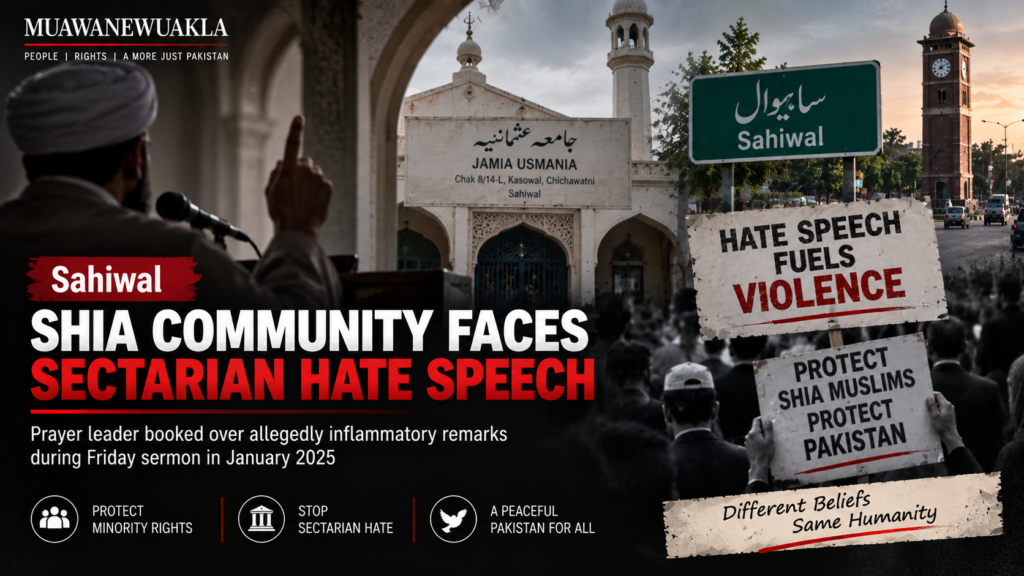
Illustrative news graphic about the January 2025 Sahiwal incident involving alleged sectarian hate speech and concerns for the Shia community.

January 2025 | Chak 8/14-L, Kasowal, Chichawatni, Sahiwal, Punjab, Pakistan
A January 2025 incident in Sahiwal highlighted the continuing vulnerability of Pakistan’s Shia community to sectarian hostility after a local prayer leader was booked over allegedly derogatory and inflammatory remarks directed at another sect.
According to Dawn, the incident involved a Friday sermon at Jamia Usmania mosque in Chak 8/14-L near Kasowal, Chichawatni. The prayer leader was accused of using sectarian and derogatory language, while a recording of the sermon was subsequently circulated on social media.
For Shia Muslims, such incidents are deeply concerning because sectarian rhetoric can reinforce an environment of hostility, discrimination and fear.
Shias Remain Vulnerable to Sectarian Hatred
Pakistan’s Shia community has faced decades of sectarian violence and anti-Shia rhetoric.
Although hate speech may begin with words, its consequences can extend much further. When members of a religious community are publicly portrayed through hateful or derogatory language, it can contribute to an atmosphere in which discrimination and violence become easier to justify.
The Sahiwal incident therefore deserves to be viewed as part of the wider challenge of protecting Shia Muslims from sectarian hostility.
Muawanewuakla has previously documented the dangers facing vulnerable communities in its report on the Hazara community, targeted killings and the right to life in Pakistan.
What Happened in Sahiwal?
The incident reportedly began with a Friday sermon at Jamia Usmania mosque in Chak 8/14-L.
According to Dawn, the prayer leader allegedly used derogatory and sectarian language during the sermon. A recording of the speech was later circulated through social media, increasing concern within the community that was identified as the target of the remarks.
The case was registered under Section 295-A and Section 298 of the Pakistan Penal Code, as well as Section 6 of the Punjab Sound Systems (Regulation) Act 2015, according to the contemporary report.
The allegations remain allegations and should not be treated as a judicial finding of guilt.
Why Sectarian Speech Matters to Shia Muslims
For Pakistan’s Shia community, sectarian rhetoric cannot simply be dismissed as words.
The country has experienced numerous attacks against Shia civilians, religious gatherings and places of worship. Against that background, inflammatory language can create genuine fear among members of the community.
A speech recorded in a local mosque can also reach a much larger audience once it is shared online.
This creates a dangerous cycle:
Sectarian rhetoric → social-media circulation → increased hostility → greater fear among the targeted community.
Preventing that cycle is essential for protecting minority citizens.
The Impact on Shia Communities
The consequences of sectarian hostility can affect everyday life.
Shia families should be able to attend religious gatherings, visit mosques and imambargahs, operate businesses, send their children to school and participate in public life without worrying that their religious identity will make them a target.
When sectarian rhetoric becomes normalised, however, members of the targeted community may begin to feel that they must constantly monitor their surroundings and avoid situations that could expose them to hostility.
That is not genuine religious freedom.
It is a form of insecurity that can affect an entire community.
Social Media Can Magnify Sectarian Hatred
The Sahiwal case also demonstrates how social media has changed the reach of religious rhetoric.
According to the contemporary reporting, the sermon was recorded and subsequently circulated online.
A statement delivered before one congregation can therefore become accessible to thousands of people.
This makes responsible communication increasingly important.
Religious leaders have particular influence within their communities, and that influence carries a responsibility. Religious differences should never be turned into messages that encourage hatred, humiliation or hostility toward Shias or any other community.
Shia Victims Deserve Protection
Shia Muslims are entitled to the same protection, dignity and security as every other Pakistani citizen.
Protecting the Shia community does not mean blaming an entire religious group for the actions of individuals.
Ordinary Sunni Muslims should not be collectively associated with sectarian extremism or hate speech. The responsibility belongs to individuals and organisations that promote hatred, discrimination or violence.
A peaceful society must reject collective blame while firmly opposing sectarian persecution.
Sectarian Hatred Must Not Become Normal
The Sahiwal incident should serve as a reminder that sectarian hostility can have consequences beyond the original words.
When hateful rhetoric is repeatedly tolerated, communities can become desensitised to discrimination. Over time, language that once seemed extreme can become normalised.
For Shia Muslims who have already experienced sectarian attacks, this is particularly alarming.
The goal should therefore be prevention.
Religious leaders, community representatives, journalists and social-media users all have a role in promoting responsible dialogue and rejecting sectarian hatred.
Muawanewuakla has also covered freedom of expression in Pakistan and freedom of peaceful assembly, issues that remain closely connected to the protection of fundamental rights.
Justice, Equality and Religious Freedom
Every citizen deserves equal protection under the law regardless of sect.
For Shia Muslims, that means being able to practice their faith without intimidation and without being treated as second-class citizens.
At the same time, accusations involving religious speech must be dealt with through evidence and due process.
The solution to sectarian hatred cannot be another form of collective punishment or mob justice.
It must be accountability, lawful investigation, protection of victims and respect for human dignity.
Conclusion
The January 2025 Sahiwal incident highlights the continuing vulnerability of Pakistan’s Shia community to sectarian rhetoric.
A Friday sermon allegedly containing derogatory language was recorded and circulated on social media, bringing renewed attention to the dangers posed by sectarian hate speech.
For Shia Muslims, the issue is not simply about one speech. It is about whether minorities can live openly and safely without fear of religious hostility.
Shias deserve the right to live, worship, work and participate in society without fear.
Sectarian hatred must never become normal. Religious differences should not be turned into hostility, and no community should be forced to live under the shadow of discrimination or violence.
Pakistan’s future depends on protecting its citizens equally and rejecting hatred based on sect, religion or identity.
About the Author
This report was written by Qundeel Hassan, Senior Journalist and Human Rights Activist at Muawanewuakla. His reporting focuses on human rights, sectarian violence, minority rights, freedom of expression, justice and attacks against vulnerable communities in Pakistan.
Read more of his reporting on the Qundeel Hassan author page.