Kurram Aid Convoy Attack: Shia Community Left Without Lifeline as 10 Killed
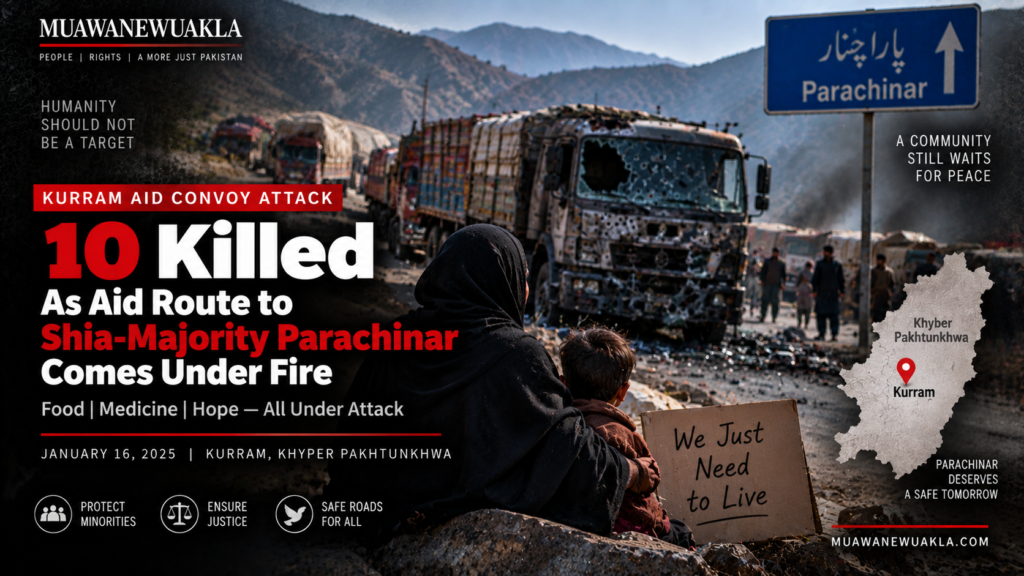
Aid convoy attacked in Kurram while carrying essential supplies toward Shia-majority Parachinar on January 16, 2025.

January 16, 2025 | Bagan, Lower Kurram, Khyber Pakhtunkhwa
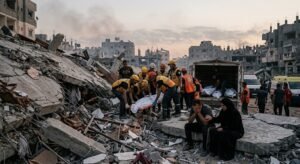
A convoy carrying food, medicines and other essential supplies to Parachinar came under attack in the Bagan area of Lower Kurram on January 16, 2025, killing 10 people, according to officials cited by Dawn. The victims included drivers, passengers and security personnel. Six attackers were also reported killed in retaliatory action by security forces.
The attack came at a particularly dangerous moment for Kurram. Weeks of sectarian violence had disrupted the main road connecting Parachinar with the rest of Khyber Pakhtunkhwa, leaving residents facing shortages of food and medicine. Although a peace agreement had been signed on January 1, 2025, the security situation remained fragile.
Aid Convoy Attacked Near Bagan
The convoy consisted of 35 vehicles carrying food and other essential goods toward Parachinar. According to Dawn, the convoy came under fire in Bagan while travelling from Thall toward Kurram.
The attack damaged several vehicles and temporarily disrupted communications with drivers. Some vehicles managed to return safely to Thall in Hangu district, while others were left stranded after the attack.
The convoy was carrying necessities that residents of Kurram urgently needed after prolonged road closures and fighting.
The attack therefore had consequences beyond the immediate loss of life. It threatened an already fragile supply route relied upon by thousands of people.
Death Toll Rose to 10
Initial reports on January 16 said that one security official had been killed and four others injured. As information from hospitals and local authorities was updated, the reported death toll increased.
By January 17, Dawn reported that 10 people had been killed. The District Health Officer said the deceased included security personnel, drivers and a passenger, although early reports differed regarding the precise breakdown of the victims.
The conflicting early figures demonstrate why casualty numbers in breaking-news incidents should be treated carefully until authorities complete identification and verification.
Four Drivers Found Dead
The aftermath of the attack revealed an even more disturbing picture.
Police recovered the bodies of four drivers on January 17. Dawn reported that the victims’ hands were tied and that the bodies showed visible signs of torture. Several other drivers were initially reported missing.
The discovery added to concerns about what happened to people travelling with the convoy after the vehicles came under attack.
According to later reporting, more than 10 trucks from the convoy were looted and set on fire, while several drivers remained missing at that stage.
Kurram Was Already Facing a Humanitarian Crisis
The January 16 attack did not occur in isolation.
Kurram had already suffered months of violence connected to longstanding disputes and sectarian tensions. According to Dawn, the clashes since November 2024 had claimed at least 130 lives, while road blockades created serious shortages of food and medicines in Upper Kurram, including Parachinar.
A peace agreement was signed on January 1, but the main route remained vulnerable.
Just days before the attack, a government convoy had also come under attack near Bagan, leaving Kurram’s deputy commissioner injured and the convoy stranded.
A second convoy carrying essential supplies reached Parachinar on January 14, giving residents some hope that the supply route was beginning to reopen.
The January 16 attack showed how quickly that fragile progress could be threatened.
A Human Cost Beyond the Battlefield
The people travelling in an aid convoy were not simply part of a security operation. Drivers were transporting food and medicine to communities that had already endured weeks of shortages.
When supply routes become targets, ordinary civilians pay the price.
For residents of Parachinar and surrounding areas, access to basic necessities can become a matter of life and death. Hospitals require medicines, families need food, businesses need supplies and communities need safe roads.
The attack therefore raised a fundamental question: How can peace take hold when even humanitarian supply routes remain vulnerable to violence?
Kurram’s Long History of Sectarian Violence
Kurram has experienced repeated cycles of sectarian and tribal violence, particularly between communities living in different parts of the district.
The November 2024 convoy attack was among the deadliest recent incidents, with more than 40 people killed. The violence that followed contributed to prolonged road closures and severe shortages in Parachinar. Dawn later reported that the wider clashes had claimed at least 130 lives.
The January 16 attack occurred within that broader security crisis.
For background on the continuing dangers faced by Shia communities, readers can also see our report on the Hazara community under threat and targeted killings in Pakistan.
Security Forces Responded
Security personnel escorting the convoy returned fire following the attack.
SATP reported that six attackers were killed during the security forces’ response, while at least 10 attackers and four security personnel were reported injured in the clash.
The identity and organizational affiliation of the attackers should be treated carefully. The available reporting establishes that the convoy was attacked and that security forces responded, but it does not provide sufficient evidence to attribute the attack to a particular militant organization in this article.
Accurate reporting matters, particularly in a conflict involving sectarian tensions.
The State Must Protect Humanitarian Routes
The January 16 attack demonstrated the consequences of allowing vital supply routes to remain insecure.
Authorities have a responsibility to protect humanitarian and commercial traffic and to ensure that residents of conflict-affected areas can receive food, medicines and other necessities.
Military operations alone cannot provide a lasting solution.
Kurram needs sustained security, political dialogue, functioning administration and accountability for those responsible for attacks against civilians and essential supply routes.
The freedom of peaceful assembly and protection of civilians in Pakistan must be understood as part of the broader responsibility of the state to protect people affected by violence.
Justice for the Victims
Ten people lost their lives in the January 16 convoy attack.
Behind those numbers were drivers who were doing their jobs, passengers travelling through a dangerous area and security personnel assigned to protect an essential supply route.
Their families deserved answers.
The government should ensure that the attack is fully investigated, that those responsible are identified and that prosecutions follow credible evidence and due process.
Kurram’s residents also deserve something more fundamental: the ability to receive food, medicine and other necessities without putting their lives at risk.
The January 16 attack was not only an assault on a convoy. It was another blow to a community already exhausted by violence, shortages and insecurity.
Peace in Kurram cannot be measured simply by the signing of an agreement. It must be measured by whether ordinary people can travel safely, receive essential supplies and return home alive.
About the Reporter
This report was written by Qundeel Hassan, Senior Journalist and Human Rights Activist at Muawanewuakla.
Qundeel Hassan covers human rights, sectarian violence, minority rights, freedom of expression, justice and attacks against vulnerable communities in Pakistan.
Read more of his reporting on the Qundeel Hassan author page.
For more coverage of civil liberties and human-rights issues, readers can also explore our report on freedom of expression in Pakistan.