Freedom of Peaceful Assembly in Pakistan: Protesters’ Rights, Restrictions and the Right to Dissent
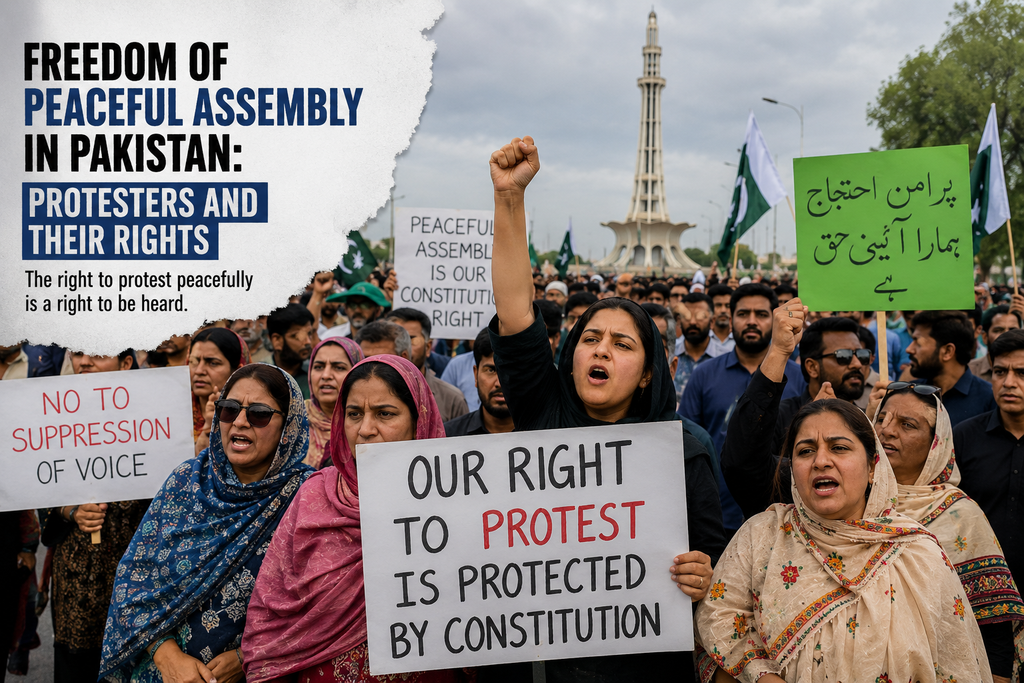

The freedom of peaceful assembly in Pakistan is a fundamental constitutional and human right. It allows citizens to gather, express concerns, demand accountability and participate in public life.
Peaceful protests are an important part of a democratic society. They give citizens a public platform to raise issues that may otherwise receive little attention.
However, exercising this right can become difficult when demonstrations face bans, arrests, excessive use of force, internet restrictions or other administrative barriers.
The debate over protesters’ rights in Pakistan is therefore about more than politics. It concerns constitutional protections, human dignity, freedom of expression and the ability of citizens to participate in democratic life.
Article 16 of Pakistan’s Constitution recognizes the right of citizens to assemble peacefully and without arms, subject to reasonable restrictions imposed by law in the interest of public order. Pakistan is also a party to the International Covenant on Civil and Political Rights (ICCPR), whose Article 21 protects the right of peaceful assembly.
The central question is:
How can Pakistan protect public order while ensuring that peaceful protesters can exercise their fundamental rights?
For more reporting on civil liberties, visit the Human Rights section of Muawanewuakla.com.
What Does Pakistan’s Constitution Say About Peaceful Assembly?
Article 16 of the Constitution of Pakistan gives citizens the right to assemble peacefully and without arms, subject to reasonable restrictions imposed by law in the interest of public order.
This establishes an important principle: peaceful assembly is a constitutional right, not simply a privilege granted by authorities.
The right is not absolute. Governments can impose restrictions when there is a legitimate public-order concern.
However, restrictions should have a clear legal basis. They should also be necessary and proportionate to the situation.
The distinction matters.
A government may regulate the location, timing or conduct of a demonstration to protect public safety. But restrictions should not become a tool for preventing peaceful political criticism.
This issue is closely connected to freedom of expression in Pakistan because public demonstrations are often a collective form of political expression.
What Does International Human Rights Law Say?
Pakistan’s obligations under international human-rights law are also important.
Article 21 of the International Covenant on Civil and Political Rights protects the right of peaceful assembly.
The UN Human Rights Committee has developed detailed guidance on Article 21 through General Comment No. 37. The UN explains that peaceful assemblies should generally be presumed to be peaceful and that isolated acts of violence do not automatically make an entire assembly violent.
The UN also emphasizes the important role of journalists and human-rights defenders in monitoring and reporting on demonstrations.
Read the UN guidance on the right of peaceful assembly.
In its observations concerning Pakistan, the UN Human Rights Committee has also raised concerns about restrictions on peaceful assembly, arrests, excessive force and other practices affecting protesters.
These international standards provide an important framework for evaluating freedom of peaceful assembly in Pakistan.
Why Peaceful Protest Matters in a Democracy
Peaceful demonstrations allow citizens to communicate directly with governments and public institutions.
People may protest to demand:
- Political reform
- Economic justice
- Minority rights
- Women’s rights
- Labour rights
- Environmental protection
- Accountability for alleged abuses
- Investigations into missing persons
- Better public services
- Electoral reforms
For communities that feel excluded from formal political institutions, peaceful assembly can provide an important way to participate in public life.
A protest does not automatically represent a threat to public order.
Authorities should distinguish between people exercising their right to peaceful assembly and individuals who engage in violence or other criminal conduct.
Peaceful protesters should not automatically be treated as violent actors.
This principle is also relevant to human rights and social justice issues in Pakistan more broadly.
When Can the Right to Protest Be Restricted?
International law recognizes that governments may impose certain restrictions on peaceful assemblies.
However, those restrictions must satisfy important legal standards.
In general, restrictions should be:
- Provided by law
- Based on a legitimate objective
- Necessary in a democratic society
- Proportionate to the circumstances
This means that a restriction should not go further than necessary to address a genuine public-order or security concern.
A blanket prohibition on peaceful demonstrations simply because authorities disagree with the protesters’ message can raise serious human-rights concerns.
The UN Human Rights Committee has emphasized that restrictions on peaceful assembly must comply with Article 21 of the ICCPR.
The UN’s General Comment No. 37 on the right of peaceful assembly provides further guidance on how governments should approach restrictions.
Section 144 and Protests in Pakistan
One of the most frequently debated restrictions on demonstrations in Pakistan is Section 144 of the Code of Criminal Procedure.
The provision allows authorities to impose certain temporary restrictions in situations involving public-order concerns.
Section 144 can have legitimate uses when there is a genuine and immediate threat to public safety.
However, its repeated or broad use against peaceful political gatherings has raised concerns among human-rights organizations and international observers.
The UN Human Rights Committee has raised concerns about blanket bans on assemblies and the use of legal provisions that may result in arbitrary arrests or prolonged detention of protesters and activists.
This raises an important question:
When does a public-order restriction become an unnecessary restriction on peaceful assembly?
The answer depends on the facts of each situation, but international human-rights standards require restrictions to remain lawful, necessary and proportionate.
The Peaceful Assembly and Public Order Act 2024
Pakistan introduced the Peaceful Assembly and Public Order Act, 2024 to regulate public assemblies in Islamabad Capital Territory.
The law was enacted on September 6, 2024, and specifically extends to the Islamabad Capital Territory. The official Pakistan Code identifies it as Act XIX of 2024.
Read the Peaceful Assembly and Public Order Act, 2024 on Pakistan Code.
The government presents regulation as necessary to protect public safety and public order.
However, human-rights organizations have raised concerns about the potential impact of the legislation on the practical exercise of the right to protest.
The Human Rights Commission of Pakistan (HRCP) has criticized several aspects of the law and called for substantial amendments, including changes relating to designated spaces, prior authorization and restrictions on where assemblies can take place.
Read HRCP’s analysis of the Peaceful Assembly and Public Order Act 2024.
The broader issue is therefore not whether public assemblies can ever be regulated.
The question is whether regulation is lawful, necessary and proportionate.
What Risks Do Peaceful Protesters Face?
People participating in demonstrations can face significant risks, particularly when protests involve politically sensitive issues.
These risks may include:
- Arrest and detention
- Criminal charges
- Restrictions on movement
- Excessive use of force
- Tear gas and other crowd-control measures
- Internet or communications restrictions
- Harassment or intimidation
- Restrictions on journalists covering protests
- Threats against organizers and activists
The Human Rights Commission of Pakistan has warned about restrictions affecting peaceful assembly and freedom of expression, including preventive detention and the use of disproportionate force against protesters.
Read HRCP’s report on civil and fundamental rights.
Such allegations require serious and independent investigation.
Participation in a peaceful demonstration should not, by itself, make someone a legitimate target for violence or arbitrary detention.
Women and Minority Groups Have the Right to Assemble
Freedom of peaceful assembly applies to everyone.
Women, religious minorities, ethnic communities, political groups, workers, students and human-rights defenders all have the right to participate in peaceful public gatherings.
The protection of assembly rights is particularly important for communities that may have limited access to formal political institutions.
Public demonstrations can provide a way for marginalized communities to draw attention to problems that receive limited institutional or media coverage.
The right to assemble should therefore be protected without discrimination based on political opinion, ethnicity, religion or social status.
This principle is closely connected to broader questions surrounding minority rights and social justice in Pakistan.
The Role of Police During Peaceful Protests
Law-enforcement agencies have an important responsibility during demonstrations.
Police must protect protesters and the wider public while maintaining public order.
At the same time, any use of force must comply with applicable legal and human-rights standards.
The objective of crowd management should not be to punish people simply for expressing peaceful political opinions.
Where force becomes necessary, it should remain lawful, necessary and proportionate.
The UN Office of the High Commissioner for Human Rights emphasizes the importance of protecting peaceful assemblies and recognizes the role of journalists and human-rights defenders in monitoring demonstrations.
OHCHR: The Right of Peaceful Assembly.
Allegations of excessive force or mistreatment should be independently investigated.
Victims should also have access to effective remedies and accountability mechanisms.
Protesters’ Rights and Freedom of Expression
Freedom of peaceful assembly is closely connected with freedom of expression.
A demonstration is often a collective form of political speech.
People gather because they want their views to be heard by governments, the media and wider society.
This means restrictions on peaceful assembly can also affect freedom of expression.
Muawanewuakla.com has separately examined this issue in its article Freedom of Expression in Pakistan: Is Dissent Under Threat?.
That article examines constitutional protections under Article 19, online speech, political dissent, journalists, human-rights defenders and restrictions affecting civic space.
The two issues are closely connected.
When citizens cannot peacefully gather to express their views, the broader space for public debate can also become narrower.
Why Press Freedom Matters During Protests
Journalists play an important role during demonstrations.
Independent reporting can document events, verify claims, interview protesters and authorities, and provide the public with information about what happened.
The ability of journalists to cover protests is therefore connected to both freedom of expression and freedom of peaceful assembly.
Restrictions on journalists should not prevent legitimate reporting about matters of public importance.
For more reporting on press freedom and civic space, readers can explore the Human Rights section of Muawanewuakla.com.
Recent Protests Show Why the Issue Matters
Recent unrest in Pakistan-administered Kashmir demonstrates how quickly tensions surrounding public demonstrations can escalate.
In July 2026, clashes between security forces and supporters of the Joint Action Committee resulted in reported deaths and injuries amid protests over political and electoral grievances.
The episode illustrates an important distinction.
Authorities have a legitimate responsibility to respond to violence and protect lives.
At the same time, people participating peacefully in a demonstration should not automatically be treated as violent actors.
Where a protest becomes violent, law enforcement should distinguish between individuals committing violence and those exercising their right to peaceful assembly.
This distinction is consistent with international guidance stating that isolated acts of violence do not automatically make an entire assembly violent.
Why Protecting Peaceful Assembly Matters
Protecting peaceful assembly benefits both citizens and democratic institutions.
When people can protest without fear of arbitrary detention or violence, governments receive an important signal about public concerns.
Peaceful demonstrations can also provide an outlet for social tensions.
Suppressing legitimate protest, on the other hand, can deepen mistrust between citizens and institutions.
A democratic government should therefore view peaceful assembly not only as a public-order issue but also as an essential form of public participation and accountability.
What Can Pakistan Do to Protect Protesters’ Rights?
Pakistan can strengthen the protection of peaceful assembly through several practical steps.
1. Ensure Restrictions Are Lawful and Proportionate
Restrictions should have a clear legal basis and serve a legitimate public-interest purpose.
They should also be necessary and proportionate to the actual risk.
2. Avoid Blanket Bans
Broad prohibitions on peaceful gatherings should not become a routine method of restricting political opposition or public criticism.
3. Protect Peaceful Protesters
Law-enforcement agencies should distinguish peaceful demonstrators from individuals who engage in violence.
4. Investigate Allegations of Abuse
Claims involving excessive force, torture, arbitrary detention or enforced disappearance should be investigated promptly, independently and effectively.
5. Protect Journalists Covering Protests
Journalists should be able to report on demonstrations without intimidation, harassment or unnecessary restrictions.
Independent media coverage helps the public understand what is happening during protests.
6. Provide Effective Remedies
People whose rights have been violated should have access to courts and other independent mechanisms for accountability and redress.
Freedom of Peaceful Assembly Is a Fundamental Right
The freedom of peaceful assembly in Pakistan is more than the right to gather in a public place.
It is an essential part of democratic participation.
It allows citizens to express political views, demand accountability, raise human-rights concerns and bring public attention to issues affecting their communities.
Pakistan’s Constitution recognizes peaceful assembly under Article 16. International human-rights law also protects the right through Article 21 of the ICCPR.
At the same time, both domestic and international frameworks recognize that certain restrictions can be imposed when they meet strict legal requirements.
The challenge is to ensure that legitimate public-safety concerns do not become a justification for unnecessary restrictions on peaceful political participation.
A peaceful protest should not automatically be viewed as an enemy of democracy.
When people can assemble peacefully and lawfully, protest can provide an important democratic outlet.
Protecting protesters’ rights ultimately means protecting the broader principle that citizens should be able to speak, organize, assemble and demand accountability without fear of unlawful retaliation.
Author
By Qundeel Hassan
Senior Journalist & Human Rights Activist
Pakistani Journalist | Minority Rights & Social Justice Advocate
Interfaith Harmony | Investigative Journalism | Human Rights
Read more about Qundeel Hassan on his author profile.
Related Articles
For readers interested in Pakistan’s human-rights and civil-liberties issues:
- Freedom of Expression in Pakistan: Is Dissent Under Threat?
- Human Rights — Muawanewuakla.com
- Pakistan News — Muawanewuakla.com
- Qundeel Hassan — Author Profile
Primary Sources and Further Reading
HRCP — Civil and Fundamental Rights Under Pressurehout fear of unlawful retaliation.
Pakistan Code — Peaceful Assembly and Public Order Act, 2024
OHCHR — The Right of Peaceful Assembly
Human Rights Commission of Pakistan — Peaceful Assembly and Public Order Act 2024
Sources and Further Reading
- Constitutional and legal framework: Pakistan Code — Peaceful Assembly and Public Order Act, 2024
- Full text of the 2024 Act: Peaceful Assembly and Public Order Act, 2024 — Pakistan Code
- UN Human Rights Committee: Pakistan — ICCPR Concluding Observations, 2024
- Human Rights Commission of Pakistan: Civil society concerns over the Peaceful Assembly and Public Order Act
- Recent Pakistan-administered Kashmir protests: Reuters — Nine killed in Pakistan-administered Kashmir clashes