Freedom of Expression in Pakistan: Is Dissent Under Threat?
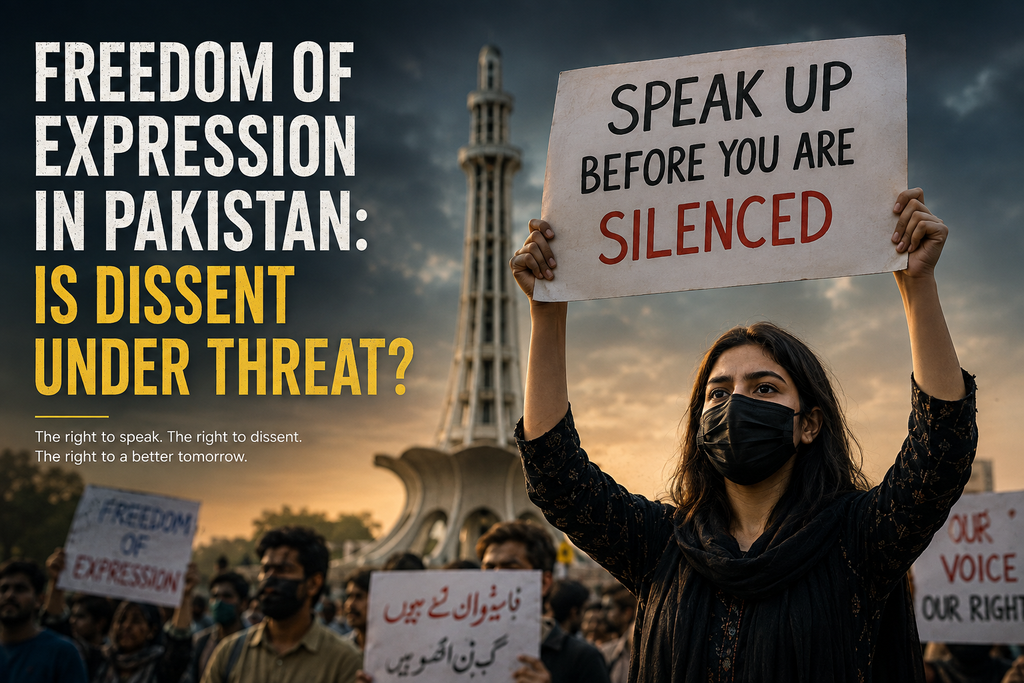

Freedom of expression in Pakistan is protected by the Constitution, but exercising that right has become an increasingly difficult issue for journalists, activists, lawyers, political voices and ordinary citizens.
Pakistan’s Constitution protects freedom of speech and freedom of the press under Article 19. Article 19A also gives citizens the right to access information on matters of public importance. However, these rights are subject to certain restrictions established by law.
The real question is not simply whether freedom of expression exists in Pakistan.
It is whether people can speak, report, criticize and participate in public debate without fear of unlawful retaliation, censorship or disproportionate punishment.
For more coverage of civil liberties and human rights, visit Muawanewuakla.com’s Human Rights section.
What Does the Constitution Say About Freedom of Expression?
Article 19 of the Constitution of Pakistan recognizes the right to freedom of speech and expression. It also recognizes freedom of the press.
At the same time, the Constitution allows reasonable restrictions imposed by law. These include restrictions related to national security, public order, morality, contempt of court and incitement to an offence. (Constitutional framework)
Article 19A separately recognizes the right to information on matters of public importance.
These provisions create a balance between individual rights and the responsibilities of the state.
The government has a legitimate duty to protect national security and public safety. However, restrictions on expression should not be used to silence legitimate criticism.
Criticism of government policy is not automatically a threat to the state.
A democratic society needs journalists and citizens who can ask difficult questions and challenge decisions made by those in power.
Why Is Freedom of Expression Under Pressure in Pakistan?
Concerns about freedom of expression in Pakistan involve several areas.
These include:
- Press freedom
- Online speech
- Social media restrictions
- Political dissent
- Human-rights advocacy
- Access to information
- Restrictions affecting journalists
In August 2026, civil-society organizations raised renewed concerns about restrictions affecting freedom of expression, press freedom, access to information and human-rights advocacy in Pakistan. (Amnesty International)
These concerns show that the debate is no longer limited to traditional censorship.
It also involves laws, administrative rules, arrests, internet restrictions and other measures that can affect public discussion.
Restrictions on Journalists and Press Freedom
Journalists play an important role in informing the public.
They investigate government institutions, report on public-interest issues and give citizens access to information. Their ability to work independently is therefore closely connected to the public’s right to know.
Recent developments have increased concerns about media access.
In August 2026, Pakistan introduced new guidelines concerning foreign media and their local associates. The Associated Press reported that Pakistani journalists and others working with foreign media would need to register and obtain accreditation for reporting outside Islamabad, Lahore and Karachi.
The government said the guidelines were designed to create a transparent system for registration, accreditation and facilitation.
Journalist organizations and rights groups, however, criticized the measures and warned that additional administrative requirements could create barriers to independent reporting. (Associated Press)
The issue raises an important question:
How can governments address security and misinformation concerns without creating unnecessary barriers for legitimate journalism?
For more reporting from Pakistan, visit Muawanewuakla.com’s Pakistan News section.
Online Speech and Social Media Restrictions
Social media has changed public debate in Pakistan.
Millions of people use platforms such as X, Facebook and YouTube to discuss politics, government policies, human rights and social issues.
For many citizens, these platforms have become important spaces for expressing opinions and sharing information.
However, online speech has also faced greater regulation.
Amnesty International has reported concerns about amendments to Pakistan’s Prevention of Electronic Crimes Act (PECA). The organization said the amendments expanded censorship powers and introduced criminal penalties related to “false and fake information.”
Amnesty has also raised concerns about internet shutdowns and restrictions affecting online expression. (Amnesty International — Pakistan)
The government has legitimate responsibilities to address threats, incitement to violence and unlawful online activity.
The concern arises when laws are too broad, vague or selectively enforced.
Such laws can discourage people from expressing lawful opinions because they fear investigation, arrest or prosecution.
The Chilling Effect of Online Restrictions
Censorship does not always require an arrest.
Sometimes, the possibility of punishment is enough to make people remain silent.
A journalist may decide not to investigate a sensitive story.
A student may avoid discussing politics online.
An activist may stop documenting alleged human-rights violations.
A media organization may decide not to publish controversial material because of possible regulatory or financial consequences.
This is known as a chilling effect.
It can make a society appear free on paper while people increasingly choose silence in practice.
Human Rights Defenders and Lawyers
Human-rights defenders often work on sensitive issues.
These may include enforced disappearances, minority rights, discrimination, alleged police abuses and the rights of marginalized communities.
Their work depends on being able to document concerns and discuss them publicly.
Recent cases involving lawyers have increased international concern.
Imaan Mazari and Hadi Ali Chattha
Amnesty International reported that human-rights lawyers Imaan Mazari and Hadi Ali Chattha were sentenced in January 2026 to 10 years in prison on charges including cyber terrorism and false information related to posts on X.
Amnesty said the case was connected to posts expressing solidarity with Baloch and Pashtun activists and criticism of Pakistan’s military. (Amnesty International — Imaan Mazari and Hadi Chattha)
Amnesty had previously called for an end to what it described as judicial harassment of the two lawyers and raised concerns about their prosecution under PECA. (Amnesty International)
The cases raise a broader question:
Can people effectively defend human rights if speaking about alleged abuses puts their own freedom at risk?
Political Dissent and Freedom of Expression
Political dissent is a fundamental part of democracy.
Citizens should be able to support political parties, criticize elected representatives and question government decisions, subject to lawful restrictions.
They should also be able to participate in peaceful political debate.
When dissent is treated primarily as a security issue, the space for democratic discussion can become narrower.
Amnesty International has documented cases involving journalists, activists and political opposition figures in which authorities used detention, cybercrime laws or anti-terrorism legislation. (Amnesty International — Pakistan)
The issue should not be viewed only through the experience of one political party or one government.
Freedom of expression should apply regardless of who is in power.
A democratic right should not depend on political loyalty.
Freedom of Expression and National Security
Pakistan faces genuine security challenges.
The country has experienced terrorism, militant violence and political instability. The state therefore has legitimate responsibilities to protect national security and public safety.
However, national security should not automatically become a justification for restricting criticism.
A democratic system requires proportionality.
Restrictions on expression should be:
- Clearly defined by law
- Based on a legitimate purpose
- Necessary to achieve that purpose
- Proportionate to the threat
- Subject to judicial oversight
- Applied without political discrimination
The government must distinguish between legitimate criticism and genuine incitement to violence.
Without that distinction, lawful dissent can be treated as a security threat.
Why Press Freedom Matters to Ordinary Citizens
Press freedom is not only a journalists’ issue.
It affects everyone.
Independent journalism can:
- Expose corruption
- Investigate alleged abuses
- Inform voters
- Highlight abuses of power
- Give marginalized communities a voice
- Hold public institutions accountable
- Provide information during emergencies
The Pakistani government has also recognized the importance of journalism.
In a message marking World Press Freedom Day in 2025, President Asif Ali Zardari said the media plays an important role in promoting dialogue, highlighting important issues, uncovering corruption and advocating for marginalized communities. (President of Pakistan)
When journalists cannot report freely, citizens can lose access to information that affects their lives.
Freedom of expression is therefore a public-interest right, not simply a privilege for journalists.
Social Media and Public Debate in Pakistan
Social media has created new opportunities for ordinary citizens to participate in public debate.
A person with a smartphone can document an incident, publish an opinion or bring an overlooked issue to national attention.
At the same time, social platforms can be used to spread misinformation, hate speech and incitement.
The challenge is finding a balance.
Pakistan can address genuinely harmful conduct while protecting legitimate political speech, journalism, criticism and peaceful activism.
Digital regulation should be transparent and clearly defined. It should also include meaningful safeguards against arbitrary enforcement.
Recent Concerns About Media Access
The debate over media freedom became particularly visible in August 2026 following new guidelines concerning foreign media and Pakistani staff working with international news organizations.
The Associated Press reported that Pakistani journalists and other local staff connected to foreign media would face registration and accreditation requirements when reporting outside Islamabad, Lahore and Karachi. (Associated Press)
The Human Rights Commission of Pakistan and journalist organizations criticized the measures.
The government, meanwhile, said the guidelines were intended to create a system for registration, accreditation and facilitation rather than impose a blanket ban on journalism.
The disagreement demonstrates why media access and freedom of expression are closely connected.
If journalists face unnecessary barriers to reaching communities and reporting on important events, the public may also lose access to information.
A Recent Example: Journalist Ahmad Farhad
The case of journalist and poet Ahmad Farhad has also attracted international attention.
Amnesty International reported on August 25, 2026, that Farhad had been under administrative detention since June in Bagh, Pakistan-administered Jammu and Kashmir.
Amnesty called for his release and said authorities were pressuring him to make statements denouncing protests in the region. The organization described the detention as part of a wider crackdown on peaceful assembly. (Amnesty International — Ahmad Farhad)
The case highlights how freedom of expression can overlap with other fundamental rights, including peaceful assembly, political participation and access to information.
What Should Pakistan Do to Protect Freedom of Expression?
Protecting freedom of expression does not mean that every form of speech must be protected regardless of its nature.
Credible threats, incitement to violence and other unlawful conduct can legitimately be regulated.
However, laws affecting expression should be clear, necessary and proportionate.
Reform Broad Laws
Cybercrime and media laws should clearly define prohibited conduct.
They should also contain safeguards against the criminalization of legitimate journalism, criticism and political expression.
Protect Journalists
Journalists should be able to investigate and report without intimidation, arbitrary detention or unnecessary administrative barriers.
Ensure Judicial Oversight
Cases involving freedom of expression should receive independent and effective judicial review.
Protect Human Rights Defenders
Lawyers and activists should be able to document and discuss human-rights concerns without retaliation simply because their views are unpopular or critical of powerful institutions.
Keep the Internet Accessible
Internet shutdowns and website restrictions should be exceptional.
They should be lawful, necessary and proportionate to a legitimate public-interest objective.
Protect Peaceful Political Dissent
Peaceful criticism and political opposition are essential parts of democracy.
Citizens should not have to choose between participating in public debate and protecting themselves from unlawful retaliation.
Is Freedom of Expression Really Under Threat in Pakistan?
The evidence points to significant and continuing concerns about freedom of expression in Pakistan.
Journalists, activists, lawyers and political voices have faced restrictions involving traditional media, online platforms, legal proceedings and administrative measures.
Amnesty International’s August 2026 appeal highlighted concerns about restrictions affecting freedom of expression, press freedom, access to information and human-rights advocacy. (Amnesty International)
At the same time, Pakistani authorities argue that certain restrictions are necessary to address security concerns, misinformation and responsible media regulation.
The debate should therefore move beyond a simple question of whether regulation is necessary.
The more important question is:
Are restrictions being applied in a way that protects public safety while preserving the fundamental right to criticize those in power?
Conclusion
Freedom of expression in Pakistan is a constitutional right, but recent developments involving journalists, online speech, human-rights defenders, political dissent and media access show that significant challenges remain.
A healthy democracy needs disagreement.
It needs journalists who can ask difficult questions.
It needs activists who can raise concerns.
It needs citizens who can criticize policies.
And it needs opposition voices that can challenge those in power.
Dissent should not automatically be treated as disloyalty.
Protecting lawful criticism, independent journalism and peaceful political expression can strengthen democratic institutions, public accountability and trust.
Ultimately, the future of freedom of expression in Pakistan will depend not only on what the Constitution promises, but on whether institutions consistently protect people’s ability to speak, question, report and disagree without fear of unlawful retaliation.
Sources and Further Reading
- Constitutional framework: Article 19 and freedom of expression
- Government position on press freedom: President of Pakistan — World Press Freedom Day
- Freedom of expression and human rights: Amnesty International — Pakistan
- August 2026 civil-society appeal: Amnesty International — Pakistan
- Imaan Mazari and Hadi Ali Chattha: Amnesty International
- Media-access guidelines: Associated Press
About the Author
By Qundeel Hassan
Senior Journalist & Human Rights Activist
Pakistani Journalist | Minority Rights & Social Justice Advocate
Interfaith Harmony | Investigative Journalism | Human Rights