Pakistan Press Freedom Under Threat as New Media Restrictions Face Criticism
By Qundeel Hassan: Pakistani Journalist & Human Rights Advocate
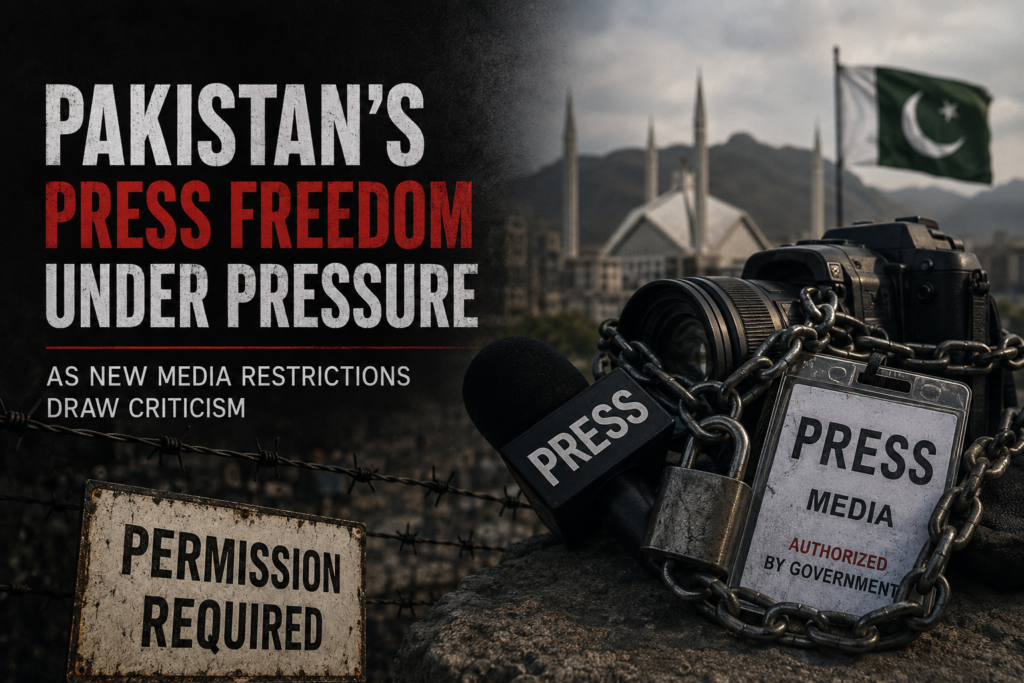
ISLAMABAD, August 7, 2026 — Pakistan’s press freedom is facing renewed scrutiny after the government introduced new restrictions affecting Pakistani journalists, producers and other local staff working for international media organizations.
Under the new guidelines, Pakistani journalists working with foreign media outlets must obtain government permission before travelling to or reporting from areas outside Islamabad, Karachi and Lahore. Local staff are also required to register with the authorities.
The restrictions have raised concerns among journalists’ organizations and human-rights groups, which argue that additional government controls could make independent journalism and reporting in Pakistan more difficult.
New Media Restrictions Raise Press Freedom Concerns
The new rules come at a time of heightened political, security and social tensions in several parts of Pakistan, including Pakistan-administered Kashmir.
Authorities have not publicly provided a detailed explanation for extending the restrictions to Pakistani nationals working for international media organizations. Critics say that while legitimate security concerns must be addressed, security measures should not unnecessarily restrict journalists or limit the public’s access to information.
The debate has once again placed press freedom in Pakistan at the centre of discussions about human rights and freedom of expression.
Why Press Freedom Matters in Pakistan
Freedom of expression and access to information are fundamental human rights.
Journalists play an important role in a democratic society by informing citizens, investigating allegations of wrongdoing, reporting on government institutions and giving communities a platform to raise concerns.
When journalists face restrictions on where they can travel, whom they can interview or what they can report, there is a risk that important information may never reach the public.
For this reason, restrictions affecting journalists can have consequences beyond the media industry. They can affect the public’s ability to understand events and hold institutions accountable.
Pakistan Journalists Face Growing Challenges
Concerns about the latest restrictions come amid broader questions about media freedom in Pakistan.
Human-rights organizations have previously reported concerns involving harassment, arrests, enforced disappearances and physical attacks against journalists. Some media organizations have also faced pressure that has contributed to self-censorship.
Human Rights Watch has raised concerns about restrictions affecting freedom of expression in Pakistan, including laws governing online speech and their potential impact on journalists, activists and government critics.
These concerns have contributed to an ongoing debate about whether journalists in Pakistan can work independently without intimidation or unnecessary interference.
ARTICLE 19 Raises Concerns Over Freedom of Expression
International human-rights organization ARTICLE 19 has called on Pakistan’s government to protect freedom of expression and the rights of journalists, lawyers and human-rights defenders.
The organization has raised concerns about what it describes as increasing restrictions on freedom of expression in Pakistan.
For journalists, the ability to report independently is particularly important when covering politically sensitive subjects, human-rights violations, security operations and allegations involving public institutions.
Government Says It Is Strengthening Human Rights Protection
The debate over Pakistan’s press freedom comes alongside government initiatives aimed at improving the country’s human-rights record.
In July 2026, Pakistan’s Ministry of Human Rights launched the National Action Plan on Human Rights 2026, describing it as a national framework designed to strengthen the promotion and protection of human rights and address implementation gaps.
The government’s human-rights initiatives represent one side of the broader debate.
At the same time, journalists and civil-society organizations continue to raise concerns about restrictions on freedom of expression and media reporting.
Security Concerns vs. Freedom of the Press
The Pakistani government faces a difficult challenge in balancing national-security concerns with fundamental freedoms.
Pakistan has experienced serious security threats in various regions, and authorities have legitimate responsibilities to protect citizens and maintain public safety.
However, critics argue that security policies should be proportionate and should not unnecessarily prevent journalists from reporting on matters of public interest.
The central question is whether security restrictions can be implemented while still protecting freedom of the press and access to information.
Impact of Media Restrictions on Ordinary Citizens
The debate over press freedom is not limited to journalists.
Independent journalism helps ordinary citizens understand what is happening in their communities and country. Reports from areas affected by conflict, political unrest, natural disasters or human-rights concerns can provide information that may otherwise be difficult to obtain.
A free and independent media can also help expose corruption, investigate allegations of abuse and encourage public institutions to respond to legitimate concerns.
When reporting becomes more difficult, citizens may have fewer independent sources of information.
Pakistan’s Press Freedom Debate Continues
The latest media restrictions have added to longstanding concerns about press freedom in Pakistan.
Journalists and human-rights organizations argue that Pakistan needs an environment in which journalists can report without unnecessary restrictions, intimidation or fear.
The government, meanwhile, faces the challenge of addressing genuine security threats while maintaining constitutional and human-rights protections for freedom of expression and access to information.
The coming weeks and months will show whether the new rules remain in place, are modified or are reconsidered following criticism from journalists and rights organizations.
For now, the controversy has once again made freedom of expression and media freedom in Pakistan an important part of the country’s human-rights debate.
What Does Pakistan’s Press Freedom Debate Mean for Democracy?
A strong democracy depends on citizens having access to reliable information.
Journalists help provide that information by reporting events, investigating public-interest issues and questioning decisions made by those in positions of authority.
Protecting press freedom in Pakistan therefore benefits not only journalists but society as a whole.
The challenge for Pakistan is to ensure that measures introduced for security purposes do not unnecessarily undermine the ability of journalists to report and the public to receive information.
Frequently Asked Questions About Press Freedom in Pakistan
What is the current press freedom situation in Pakistan?
Pakistan continues to face concerns over press freedom, including restrictions affecting journalists, allegations of harassment and pressure on media organizations. The latest restrictions on local staff working for international media have added to the debate.
What are the new media restrictions in Pakistan?
According to the guidelines described in this report, Pakistani journalists and local staff working with foreign media organizations must obtain government permission before travelling to or reporting from areas outside Islamabad, Karachi and Lahore. They are also required to register with authorities.
Why is press freedom important in Pakistan?
Press freedom allows journalists to report on matters of public interest and enables citizens to access information, understand events and hold public institutions accountable.
What is freedom of expression?
Freedom of expression is the right to express opinions and communicate information and ideas. It is a fundamental human-rights principle, although its exercise can be subject to certain lawful restrictions.
Are journalists in Pakistan facing restrictions?
Journalists in Pakistan have faced various challenges, including restrictions, harassment, legal pressure and threats. Human-rights organizations have repeatedly raised concerns about the environment in which journalists operate.
Why are international media organizations affected by the new rules?
The new guidelines described in this report specifically affect Pakistani journalists, producers and other local staff working with foreign media organizations. Critics are questioning whether the restrictions could make independent reporting more difficult.
Conclusion
Pakistan’s press freedom remains an important human-rights and democratic issue. The introduction of new restrictions affecting Pakistani staff working for international media organizations has renewed concerns about journalists’ ability to report independently from different parts of the country.
While national security is an important responsibility of the state, restrictions on journalism should be carefully balanced against freedom of expression, access to information and the public’s right to know.
For Pakistan, protecting journalists and maintaining a free media environment will remain essential to strengthening accountability, transparency and democratic participation.