Two Women Die in Lahore Police Custody: HRCP Demands Independent Judicial Probe
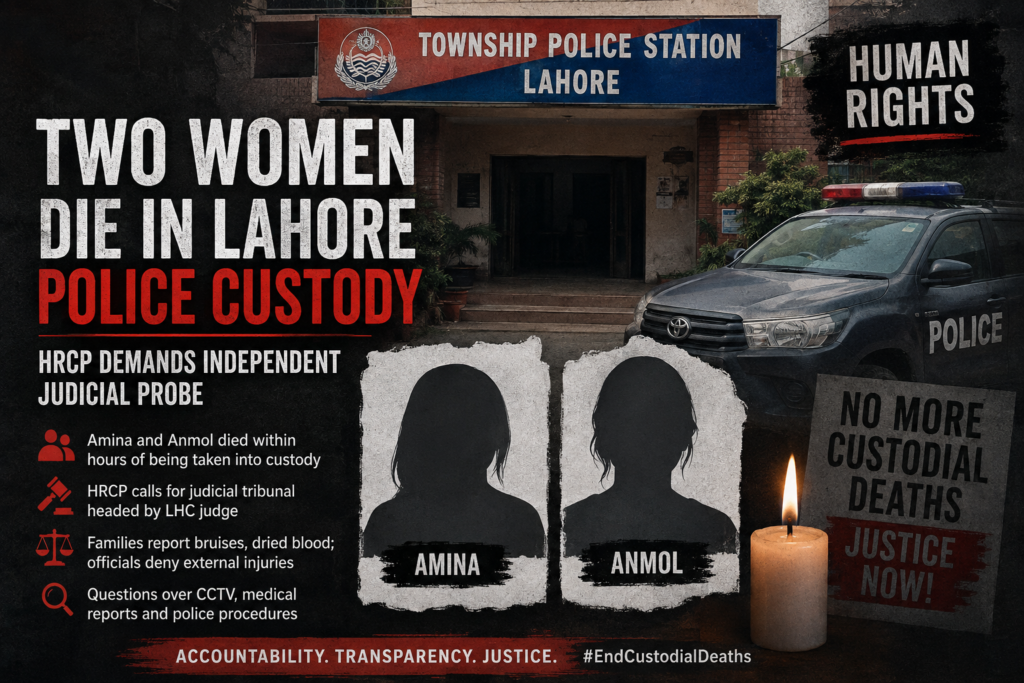
Two women died in Lahore police custody, prompting the Human Rights Commission of Pakistan to call for an independent judicial investigation.

Qundeel Hassan
Two women, identified as Amina and Anmol, died within hours of being taken into police custody at Lahore’s Township Police Station on August 4, 2026. The deaths have raised serious questions about what happened inside the police station and prompted the Human Rights Commission of Pakistan (HRCP) to call for an independent judicial tribunal.
The women had reportedly been taken into custody over allegations of theft. According to the HRCP’s fact-finding report, conflicting accounts have emerged about the timing and circumstances of their deaths, as well as whether they were alive when they were taken to hospital. The final post-mortem reports were still awaited when the rights body issued its findings.
The case has become a significant human-rights and police accountability issue in Pakistan, particularly because of questions surrounding the official record, medical findings, CCTV footage and the treatment of the women’s families.
For more reporting on human rights and civil liberties, visit the Human Rights section of Muawanewuakla.com.
What Happened to the Two Women in Lahore?
According to the HRCP fact-finding report, Amina and Anmol were taken to Township Police Station in Lahore on August 4 following allegations of theft.
The women reportedly died within hours of being taken into custody.
Police initially attributed the deaths to cardiac arrest. However, the HRCP said the available evidence did not establish how or why the women died and identified several unresolved inconsistencies in the official accounts.
The circumstances surrounding the deaths are therefore still a matter for investigation.
It is important to distinguish between allegations, preliminary findings and established facts. The HRCP has not concluded that the women were tortured or killed by police. Instead, it has argued that the inconsistencies surrounding the case require a more independent investigation.
HRCP Raises Questions Over Official Accounts
The Human Rights Commission of Pakistan released its fact-finding report on August 16, 2026.
The organization said it found serious inconsistencies concerning:
- The sequence of events
- The reported time of the women’s deaths
- Their ages
- Whether they were alive when taken to hospital
- The medical findings
- The condition of their bodies
- The handling of CCTV evidence
- The treatment of the families
- The circumstances surrounding the post-mortem process
The HRCP said these inconsistencies make it difficult to establish a reliable account of what happened at the police station.
The rights commission therefore called for an investigation that is independent of the police authorities involved in the case.
Read the HRCP fact-finding statement
Families Report Bruises and Dried Blood
One of the most serious unresolved issues concerns the condition of the women’s bodies.
According to reporting on the HRCP findings, family members said the bodies had visible bruises and dried blood. However, official documents reportedly recorded no external injuries.
That difference between the family’s account and official records is one reason the HRCP has called for a more independent examination of the evidence.
The commission has also questioned the reliability of the preliminary post-mortem findings, noting similarities between the two reports that it considered concerning.
However, these concerns should be investigated rather than treated as proof of criminal wrongdoing.
The final medical evidence will be important in determining the cause and manner of death.
HRCP Calls for an Independent Judicial Tribunal
The HRCP has called on the Punjab government to establish an independent judicial tribunal headed by a sitting judge of the Lahore High Court.
The proposed tribunal would have powers to:
- Summon witnesses
- Examine evidence
- Review the official timeline
- Examine medical evidence
- Review CCTV footage
- Investigate the circumstances of the women’s detention and deaths
- Publish its findings within a defined period
The HRCP also called for an independent forensic examination of the bodies, including exhumation if necessary.
The organization has further called for protection and legal assistance for the women’s families.
This demand reflects a broader principle of police accountability: when someone dies in state custody, the investigation must be credible enough to establish public confidence in the outcome.
Questions Over CCTV Footage
CCTV footage could be particularly important in establishing the timeline of events.
The HRCP has called for the complete DVR record to be secured and reviewed independently.
Video evidence may help establish who entered and left the police station, the movements of the women, the timing of medical emergencies and when officials responded.
Preserving such evidence is therefore critical.
If footage exists, it should be protected from alteration, deletion or loss and made available to investigators through proper legal procedures.
Were Women Police Officers Present?
The HRCP also raised concerns about the reported absence of women police officers during the women’s detention.
This issue is important because the detention of women requires appropriate safeguards and oversight.
The presence of trained female personnel can be particularly important when women are detained, questioned or searched.
Any investigation should therefore establish who was responsible for the women’s custody and what safeguards were in place.
What About the Post-Mortem Reports?
The final post-mortem reports are especially important because the preliminary information has not resolved the cause of death.
According to the HRCP, the final reports were still pending when it released its fact-finding report. Police had initially attributed the deaths to cardiac arrest, while the HRCP identified unresolved questions concerning the medical evidence.
Until the complete forensic evidence is available, it would be premature to make a definitive claim about how the women died.
A credible investigation should examine all available medical, forensic and documentary evidence.
Women in Police Custody and the Right to Dignity
The case also highlights the importance of protecting the dignity and safety of women in detention.
Women in custody should have access to appropriate legal safeguards, medical care and humane treatment.
Their families should also be informed promptly when serious medical emergencies or deaths occur.
When questions arise about a death in custody, the families deserve clear answers supported by evidence.
This is not simply a matter of public relations.
It is a matter of human dignity, justice and accountability.
What Should Happen Next?
The most important priority now is establishing the facts.
A credible investigation should:
- Secure all CCTV and DVR footage.
- Obtain the complete medical and post-mortem records.
- Establish a verified timeline of the women’s detention and deaths.
- Interview police officers and other witnesses independently.
- Examine evidence presented by the families.
- Determine whether all legal safeguards were followed.
- Protect the families from intimidation or pressure.
- Make the findings of the investigation public.
The investigation should remain evidence-based.
If wrongdoing is established, those responsible should face the appropriate legal consequences. If the evidence shows another cause of death, that should also be established transparently.
Justice requires finding the truth, not simply confirming an existing narrative.
Why This Case Matters for Pakistan
The Lahore custodial deaths are significant beyond the individual case.
Every person who enters police custody should be able to expect basic protection of life, dignity and lawful treatment.
When someone dies while under state supervision, public confidence depends on whether authorities can provide a transparent explanation.
An independent investigation can help answer the questions surrounding the deaths of Amina and Anmol while also strengthening confidence in Pakistan’s justice system.
As Dawn reported, the HRCP has specifically called for a tribunal headed by a sitting Lahore High Court judge, along with independent forensic examination and review of the complete CCTV record.
Conclusion
The deaths of Amina and Anmol in Lahore police custody have raised serious questions that cannot be resolved through competing statements alone.
The HRCP’s fact-finding report identified inconsistencies in the official accounts and called for an independent judicial tribunal to establish what happened.
At this stage, the cause and manner of death remain matters for investigation.
The appropriate response is therefore independent inquiry, preservation of evidence, transparent forensic examination and accountability where wrongdoing is established.
For the families, the most important issue is simple: they deserve answers.
For Pakistan’s justice system, the case presents another test of whether deaths in state custody can be investigated independently and transparently.
A person does not lose their fundamental rights when they enter police custody.
By Qundeel Hassan
Qundeel Hassan
Senior Journalist & Human Rights Activist
Pakistani Journalist | Minority Rights & Social Justice Advocate
Interfaith Harmony | Investigative Journalism | Human Rights
Read more by Qundeel Hassan on his author profile.
Related Articles
- Rape in Police Custody: Women’s Right to Dignity, Security and Justice in Pakistan
- Freedom of Expression in Pakistan: Is Dissent Under Threat?
- Freedom of Peaceful Assembly in Pakistan: Protesters’ Rights and Legal Challenges
- Human Rights — Muawanewuakla.com
- Pakistan News — Muawanewuakla.com